


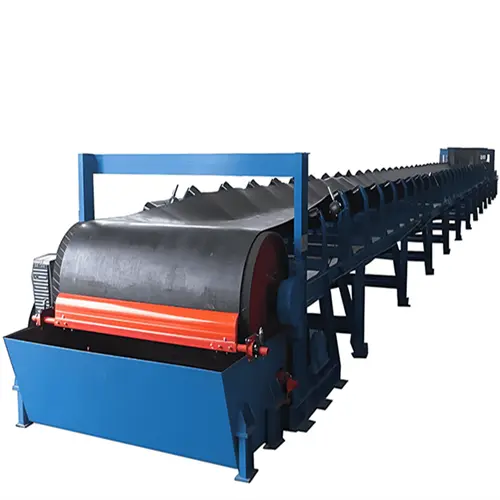
Belt Feeder
Features and Advantages of Belt Feeder
Precise and Controllable: Enables accurate control of feeding rates through variable frequency speed regulation or mechanical adjustment, ensuring uniform material supply to the Raymond mill.
High Adaptability: Suitable for conveying wet, sticky, high-temperature, or mildly corrosive materials, with belt materials designed for heat resistance, anti-adhesion, and wear resistance. Components such as flat belts, sidewall belts, or sealed covers can be flexibly configured based on material characteristics.
Stable and Reliable: Features a simple mechanical structure, smooth power transmission, and minimal impact vibration, resulting in low failure rates during long-term operation.
Easy Integration: Can be seamlessly integrated with equipment such as load cells, iron removers, and dust covers. It can also be upgraded to a quantitative feeding system or a fully enclosed dust-proof system.
Working Principle of Belt Feeder
Continuous Conveying: The motor drives the drum to rotate, which, through friction, moves the endless belt in a cyclic motion. Materials are transported synchronously with the belt, achieving continuous feeding.
Flow Rate Control: Feeding rates can be steplessly and precisely regulated by adjusting belt speed via variable frequency drives and controlling material bed thickness with gates.
Functional Expansion: By adding a weighing bridge and speed sensors to the frame, it can be upgraded to a high-precision quantitative feeder. Equipping it with a fully sealed cover enables dust-free conveying.
- How to construct a standard foundation for a Raymond Mill?
- Can Sand‑Powder Integrated Machines Truly Achieve Co‑production? Equipment Selection Guide
- Deep‑Dive Analysis of Working Principle of Raymond Mill
- Why do the grinding roller shaft and the central shaft of a Raymond mill need to undergo heat treatm
- European Version, German Version, Vertical Swing Type Grinding Mills: Genuine Upgrade or Fake Concep
- Can a Raymond mill grind multiple materials together?
 Home
Home Products
 About
About Call
Call