

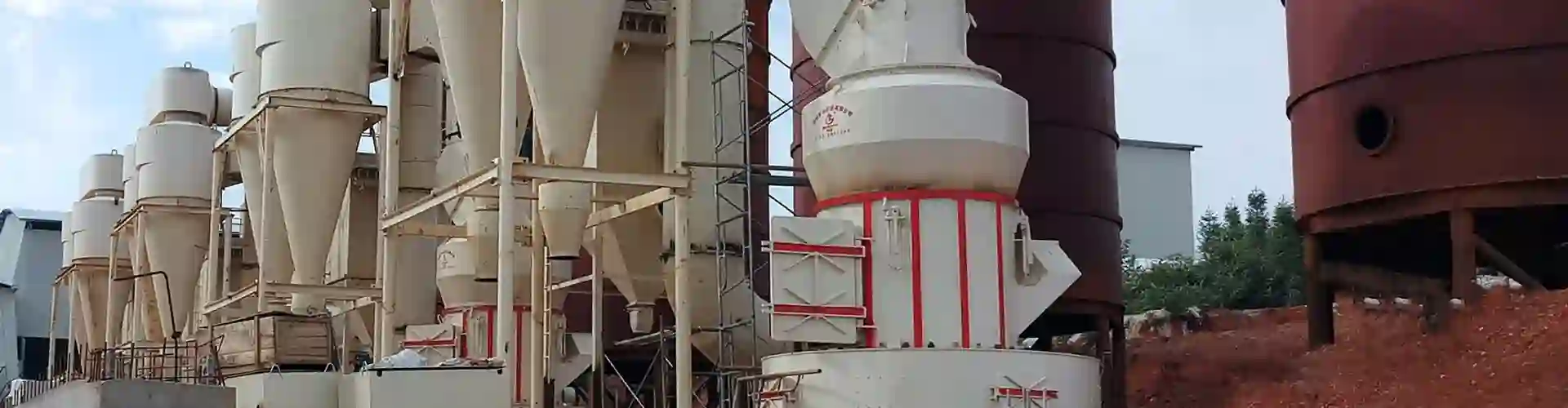
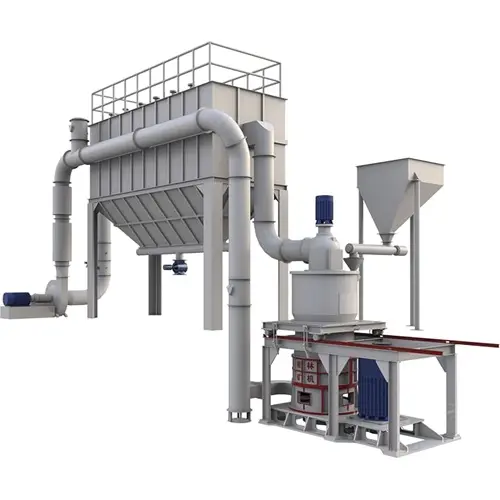
CRHGM Ultrafine Grinding Mill
Feed Size:≤20mm
Production Output:0.6~10t/h
Product Fineness:400~2500 mesh
Suitable Materials:Limestone, marble, calcite, barite, dolomite, granite, bentonite, kaolin, bauxite, talc, fluorite, gypsum, graphite, carbon black, quicklime, calcium carbonate, magnesium oxide, etc.
Ultrafine Grinding Mill Introduction
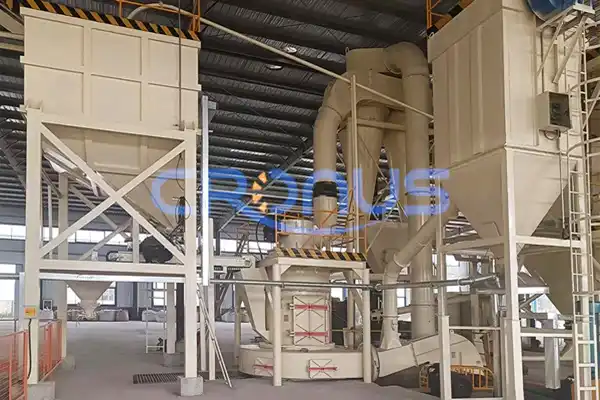
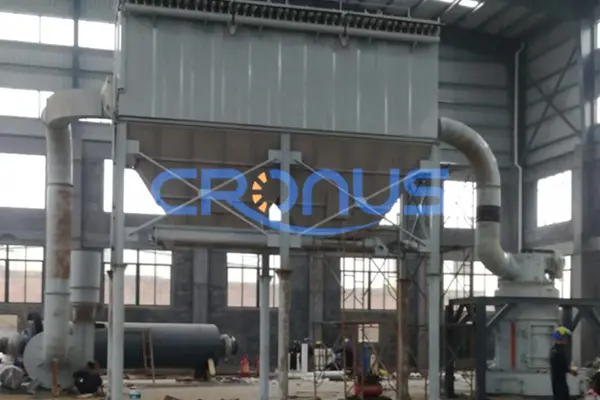
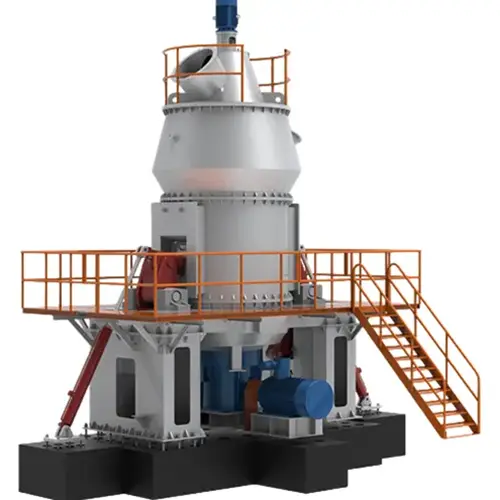
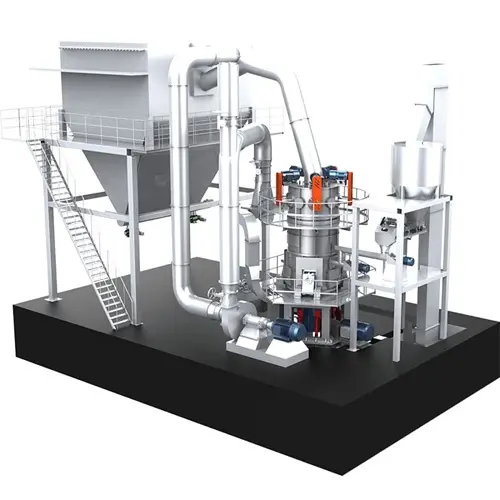
CRHGM Ultrafine Grinding Mill is an ultrafine grinding equipment developed by Cronus Machinery based on traditional ring roller mills. It features multi-layer grinding rollers and rings (2~4 layers) for layer-by-layer material grinding, and adopts a high-precision centrifugal turbo classifier in the classification system. The finished product exhibits excellent particle shape, good flowability, and concentrated particle size distribution (D97 < 2500 mesh, particle size < 2 μm content ≤ 30%).
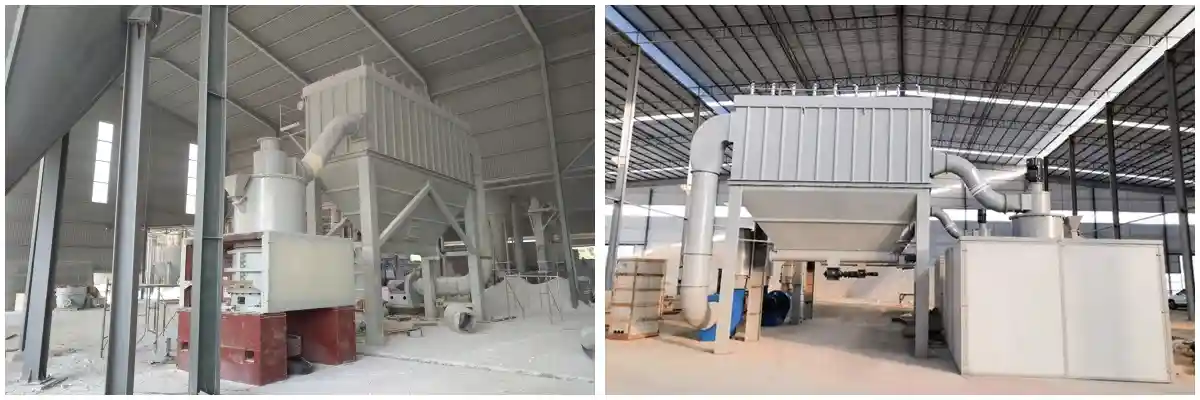
It effectively addresses issues such as insufficient fineness of Raymond mills, high energy consumption of jet mills, high investment cost of ultrafine vertical roller mills, and complex process flow of ball mill-classifier production lines. It is suitable for ordinary ultrafine powder applications in industries such as rubber, cosmetics, ceramic glazes, and feed additives.
| Ultrafine Grinding Mill Structural Components | |||
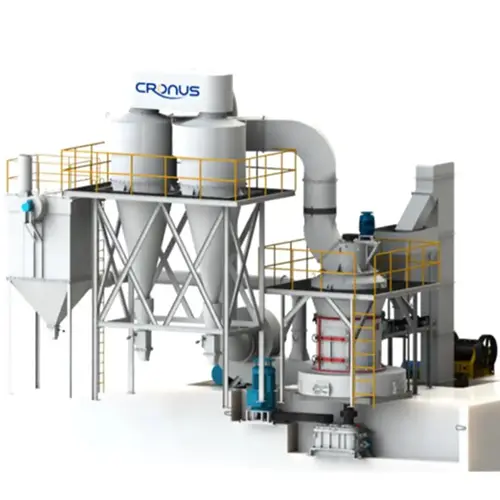
| Grinding System | Classification System | Collection System | Air Circuit System |
| Composed of multi-layer grinding rings and rollers | High-precision centrifugal turbo classifier | Cyclone collector + pulse jet baghouse dust collector | Closed negative-pressure circulating air circuit |
| Single grinding ring with multiple rollers (≥15) for repeated compression of material bed | Stepless speed control for precise fineness adjustment | Two-stage collection process, total product recovery ≥99.9% | Provides stable airflow, reduces system energy consumption |
Ultrafine Grinding Mill Features & Advantages
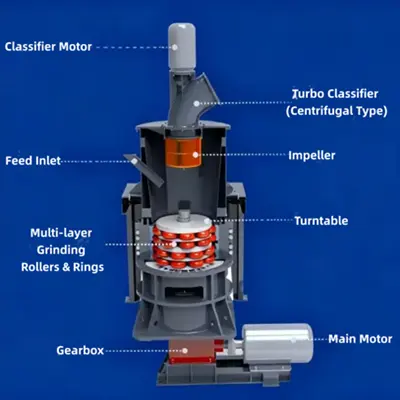
Ultrafine Classification: High-precision centrifugal turbo classifier enables stable production of 400~2500 mesh ultrafine powder with concentrated particle size distribution (D97 < 2500 mesh, particle size < 2 μm content ≤ 30%).
Excellent Particle Shape: Finished particles are mostly round with few angular edges, offering good flowability and dispersibility. Particularly suitable for applications with high particle shape requirements such as plastics, rubber, and cosmetics.
Flexible Configuration: Classifier can be flexibly configured with single-head or multi-head structure. Multi-head design offers higher precision and greater capacity. A two-stage classification system can also be added to meet higher precision requirements.
High Efficiency & Energy Saving: Multi-layer material bed grinding technology with progressive material compression ensures high energy utilization, reducing comprehensive energy consumption by 30%~50% compared to jet mills.
Cost-Effective: Initial investment cost is significantly lower than that of ultrafine vertical roller mills. The classification system can be tailored to specific needs (e.g., single-head structure + primary classification) to maximize economic efficiency.
Ultrafine Grinding Mill Process Flow
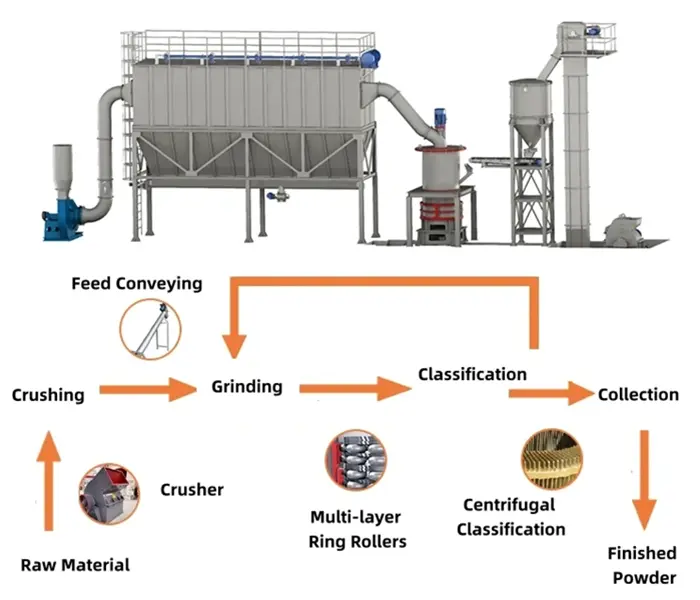
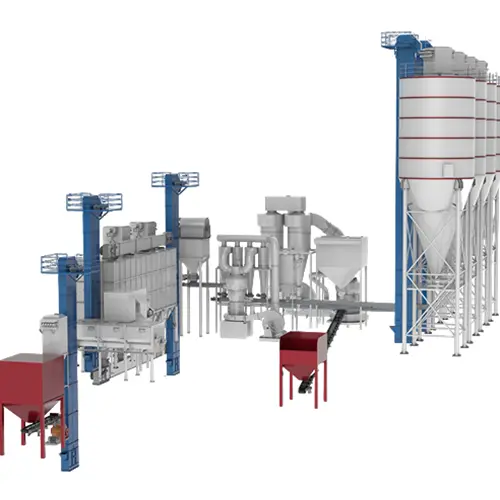
Raw Material → Crusher → Conveying Equipment → Ultrafine Grinding Mill → Cyclone Collector → Pulse Jet Baghouse Dust Collector → Finished
Crushing & Conveying
Raw materials are first coarsely crushed by a crusher to the required feed size (≤20 mm), then fed into the ultrafine grinding mill via conveying equipment (bucket elevator, vibrating feeder, etc.).
Grinding & Classification
After entering the grinding zone, the material is lifted by rotating plow blades and thrown between multiple sets of grinding rollers and rings. Driven by the rotating plate, the rollers repeatedly compress the multi-layer material bed to achieve ultrafine grinding. The ground powder is then conveyed by airflow to the centrifugal turbo classifier at the top (single-head or multi-head configuration available based on process requirements).
By adjusting the rotation speed of the classifier rotor, qualified ultrafine powder passes through the classifier wheel into the collection system, while coarse particles are thrown back into the grinding chamber by centrifugal force and fall onto the grinding ring track for regrinding, forming a closed-circuit cycle. (When processing ultrafine powder above 800 mesh, a two-stage classification system can be flexibly equipped to ensure classification precision.)
Two-Stage Classification System: Uses a "primary turbo classifier + secondary turbo classifier" series configuration. The classifiers are independently external, connected to the main unit and fan via piping. After grinding, the material is conveyed by airflow to the primary classifier for pre-classification, then the semi-finished product enters the secondary classifier for fine classification. The speeds of both primary and secondary classifiers can be independently adjusted via VFDs, achieving extremely concentrated particle size distribution with virtually no coarse particles.
Collection & Dust Removal
Finally, qualified powder enters the cyclone collector with the airflow for gas-solid separation. The majority of powder is collected as finished product, while residual dust enters the pulse jet baghouse dust collector for recovery and purification. The purified clean gas (concentration ≤10 mg/m³) is discharged by the fan. The entire system operates under negative pressure with no dust leakage.
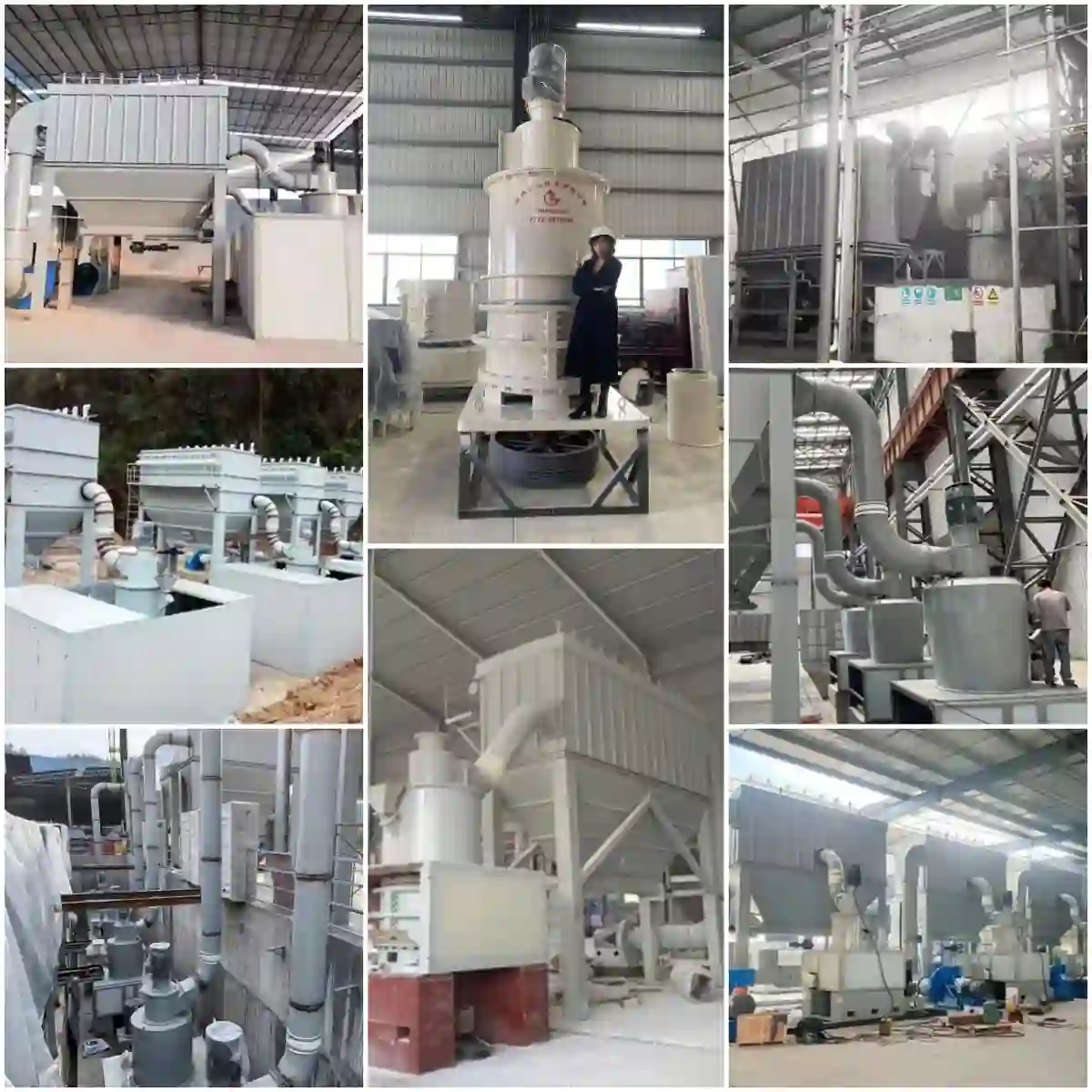
Ultrafine Grinding Mill Application Scenarios
Ultrafine Grinding Mill Technical Parameters
| CRHGM Ultrafine Grinding Mill Parameter Comparison Table (X Model) | ||||||
| Fineness (D97) | CRHGM1000X | CRHGM2000X | CRHGM3000X | |||
Capacity (kg/h) | Total Power (kW) | Capacity (kg/h) | Total Power (kW) | Capacity (kg/h) | Total Power (kW) | |
| 800 | 2500~2800 | 152 | 4000~4500 | 237 | 5500~7000 | 287~340 |
| 1250 | 1500~1800 | 2500~3000 | 3500~4000 | |||
| 1500 | 1000~1300 | 1800~2200 | 2500~3000 | |||
| 2000 | 650~750 | 1200~1500 | 1500~2000 | |||
| 2500 | 600~650 | 800~1000 | 1100~1500 | |||
| 3000 | / | / | / | / | 1000~1200 | |
| * The above data is for reference only. Specific parameters vary depending on materials. | ||||||
| CRHGM Ultrafine Grinding Mill Parameter Comparison Table (C Model) | ||||
| Fineness (D97) | CRHGM1000C | CRHGM3000C | ||
Capacity (kg/h) | Total Power (kW) | Capacity (kg/h) | Total Power (kW) | |
| 400 | 5500~6200 | 237 | 9000~9500 | 280 |
| 600 | 4000~4500 | 6500~7500 | ||
| 800 | 3600~4300 | 6000~6500 | ||
| * The above data is for reference only. Specific parameters vary depending on materials. | ||||
Frequently Asked Questions About Ultrafine Grinding Mills
Does single-head and multi-head in ultrafine grinding mills refer to primary and secondary classification systems?
No. Single-head and multi-head refer to the equipment structure, indicating whether the classifier has one or multiple classifier wheels. Primary and secondary refer to the process configuration, where each stage of a two-stage classification system can be flexibly designed with either single-head or multi-head classifier configuration.
What is the difference between single-head and multi-head classifier structures in ultrafine grinding mills?
Single-Head Classifier: Uses a single large classifier with compact structure and low cost, but limited capacity and precision.
Multi-Head Classifier: Uses multiple parallel independent classifiers working together, offering high capacity and high precision, with relatively higher cost.
How to match the classification system for ultrafine grinding mills?
Single-Head Structure + Primary Classification: Simple structure, high cost-effectiveness, suitable for budget-limited basic projects.
Multi-Head Structure + Primary Classification: Large processing capacity, high classification precision, suitable for small to medium-scale conventional ultrafine powder processing.
Single-Head Structure + Two-Stage Classification: Extremely narrow particle size distribution, suitable for high-end ultrafine powder applications.
Multi-Head Structure + Two-Stage Classification: Maximum capacity and highest classification precision, suitable for large-scale production of high-value-added ultrafine powder.
Can ultrafine grinding mills process medium-fine powder?
It can process medium-fine powder, but with performance surplus and relatively low cost-effectiveness. Ultrafine grinding mills are ultrafine grinding equipment primarily designed for 400~2500 mesh ultrafine powder processing. When processing 80~400 mesh medium-fine powder, the classifier speed and system airflow must be significantly reduced, preventing efficient grinding. Additionally, the equipment cost is not as economical as Raymond mills. It is generally not recommended to use ultrafine grinding mills for medium-fine powder processing, unless there are future plans to upgrade to ultrafine powder production.
Can ultrafine grinding mills process high-hardness materials?
Ultrafine grinding mills are suitable for grinding brittle materials with Mohs hardness ≤7 and are not suitable for processing high-hardness materials, as this would accelerate wear on grinding rollers and rings. For ultrafine powder processing of high-hardness materials, ball mill-classifier production lines are typically used.
 Home
Home Products
 About
About Call
Call