

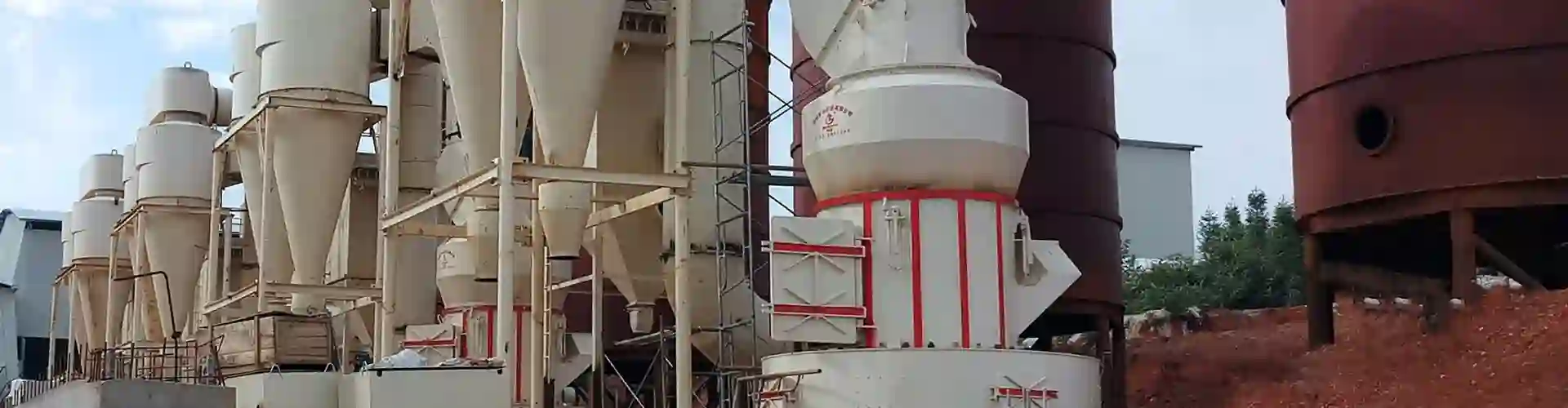
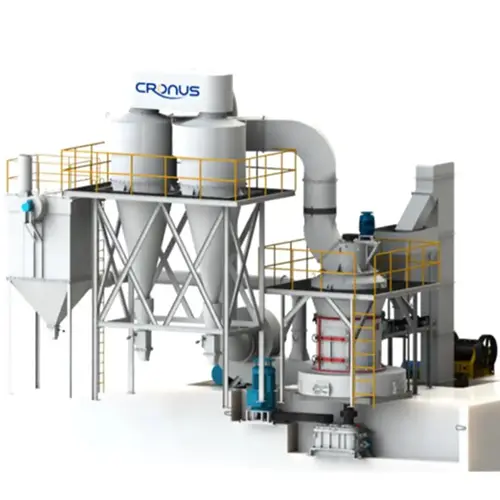
CRRM Raymond Mill
Feed Size:≤35mm
Production Output:1~80t/h
Product Fineness:80~400 mesh
Suitable Materials:Limestone, marble, calcite, barite, dolomite, granite, perlite, bentonite, kaolin, bauxite, talc, fluorite, zeolite, mica, gypsum, graphite, quicklime, calcium carbonate, activated carbon, etc.
Raymond Mill Introduction
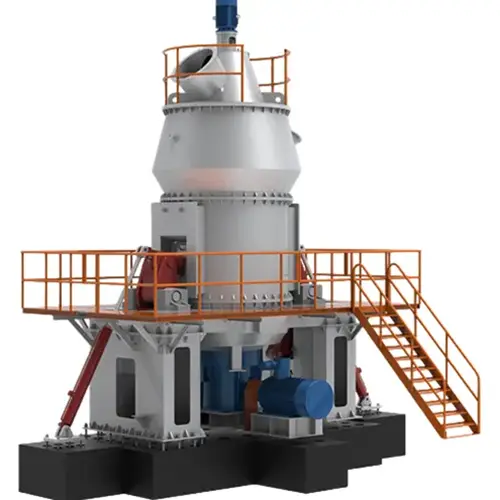
The CRRM Raymond Mill is a core product continuously developed and improved by Cronus Machinery based on the traditional pendulum mill, embodying 50 years of industry experience. It offers outstanding advantages in the processing of medium-fine powder in the 80~400 mesh range: lower operating energy consumption than ball mills, higher production efficiency than ultra-fine grinding mills, and lower investment cost than vertical roller mills, producing uniform medium-fine powder (D97 < 325 mesh, <2μm particle size content <10%). It is suitable for grinding non-metallic minerals with Mohs hardness ≤7 and moisture content ≤6%, and is widely used in mining, building materials, chemical, metallurgy, environmental protection, and other industries.
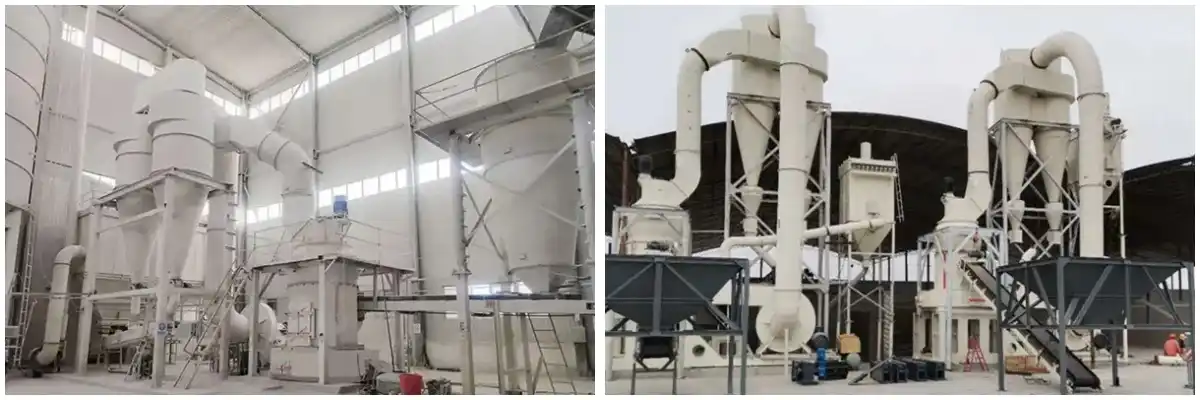
| Raymond Mill Structural Components | ||||
| Grinding System | Classification System | Collection System | Dust Removal System | Air Circuit System |
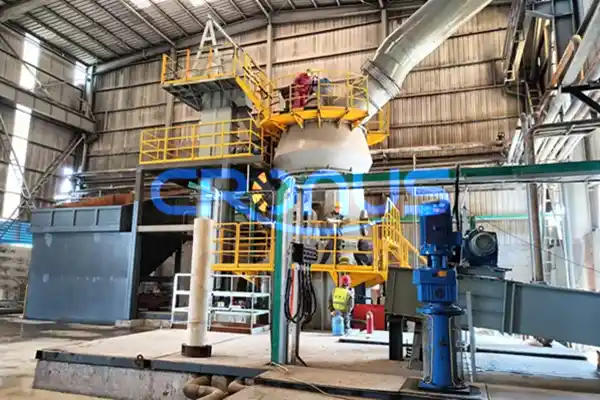
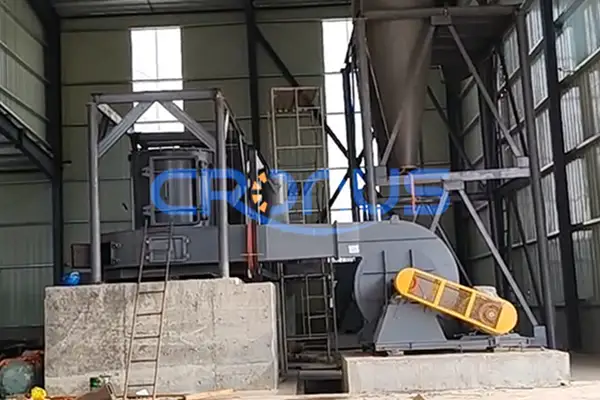
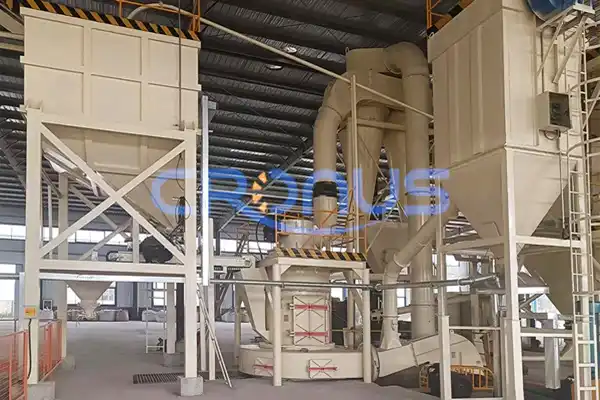
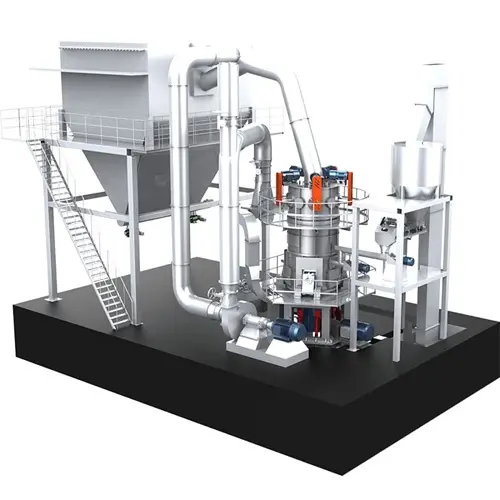
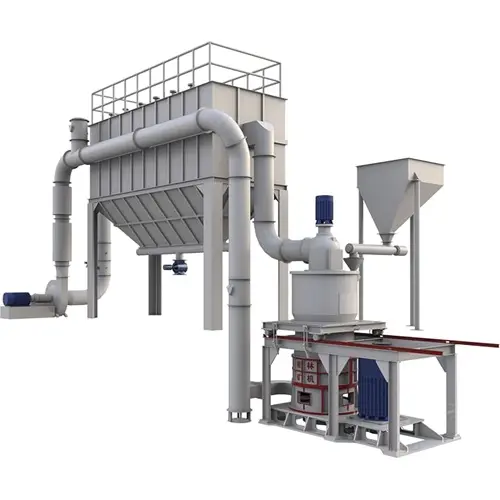
| Composed of grinding rollers, grinding rings, plow blades, quincunx frame, motor, reducer, etc. | Dynamic classifier consisting of rotor and blades | Parallel twin-cyclone design | Pulse jet baghouse dust collector | Composed of fan and piping |
| Responsible for material grinding | Controls finished product fineness | Collects most of the finished fine powder | Collects residual dust, purifies exhaust gas | Provides system airflow, creates negative-pressure enclosed environment |
Raymond Mill Features & Advantages
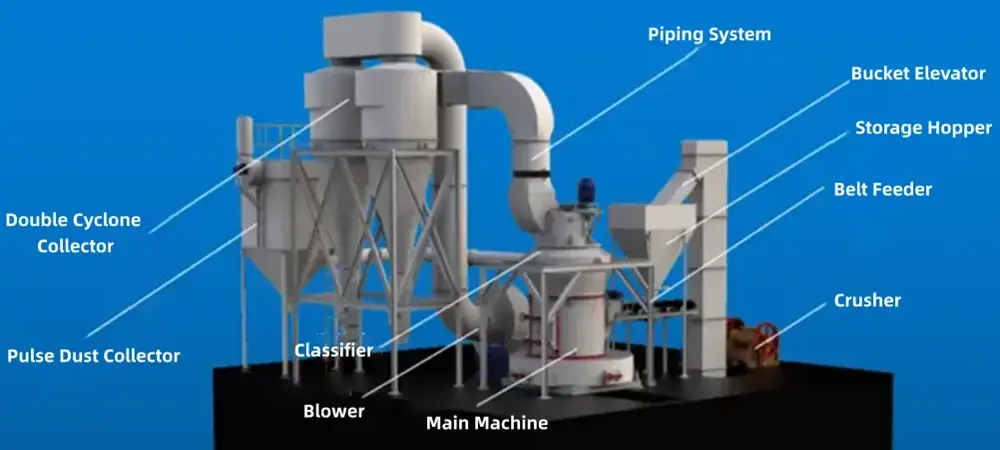
Compact Design: Vertical structure with simple design, small footprint, reducing floor space by over 50% compared to ball mills.
High Efficiency & Energy Saving: Twin-cyclone design improves collection efficiency by 10%~15% over single cyclone, reducing overall energy consumption by 30%~40% compared to ball mills.
Precise & Controllable: Finished product fineness precisely controllable from 80~400 mesh, stable output, uniform particle size, 325 mesh passing rate ≥95%.
Environmentally Friendly: Negative-pressure closed design effectively suppresses noise and dust leakage, equipped with two-stage dust collection system, exhaust emission concentration ≤10mg/m³ (GB 16297-1996 key area standard ≤30mg/m³).
Wear-Resistant & Economical: Grinding rollers and rings are made of high manganese steel or alloy steel such as 100Cr6 or C45, ensuring long service life. Purchase cost is only one-third that of vertical roller mills.
Raymond Mill Process Flow
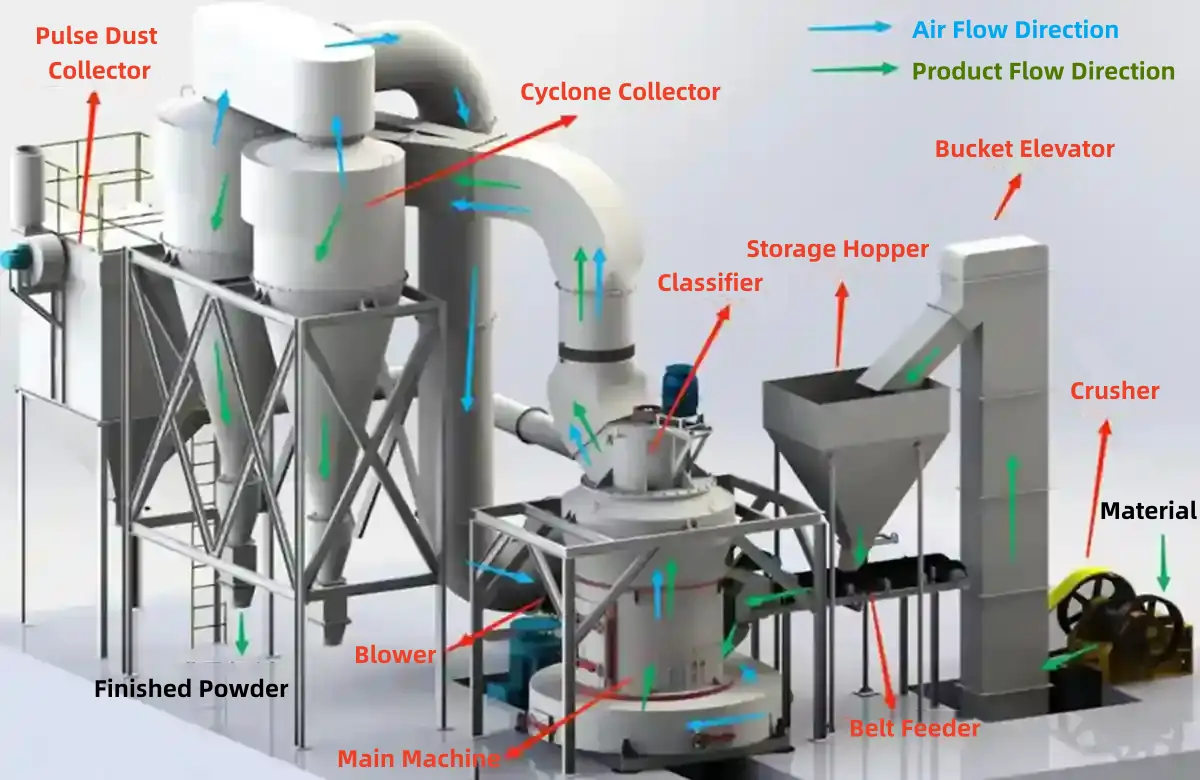
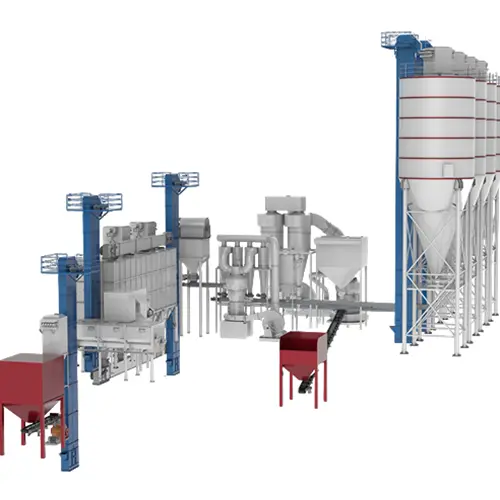
Raw Material → Crusher → Elevator → Feeder → Raymond Mill → Cyclone Collector → Pulse Jet Baghouse Dust Collector → Finished
Raw Material Preparation
Large pieces of material are first crushed by a crusher (typically a jaw crusher) to the size required for mill feed (≤35mm). If material moisture exceeds 6%, drying treatment (natural drying or using a dryer) is required.
After proper treatment, the material is vertically conveyed by a bucket elevator to the storage bin for buffer storage (horizontal conveying can use a belt conveyor), and then uniformly, continuously, and quantitatively fed to the Raymond mill main unit by a feeder (typically a vibrating feeder or belt feeder). If strict purity requirements are needed, equipment such as magnetic separators or vibrating screens can be used for impurity removal and purification before grinding.
Grinding & Classification
After material enters the main unit, the rotating plow blades at the bottom lift and throw it between the grinding rollers and rings, forming a material bed. Meanwhile, the grinding rollers mounted on the quincunx frame rotate with the main shaft, pressing tightly against the grinding rings under centrifugal force to crush and grind the material.
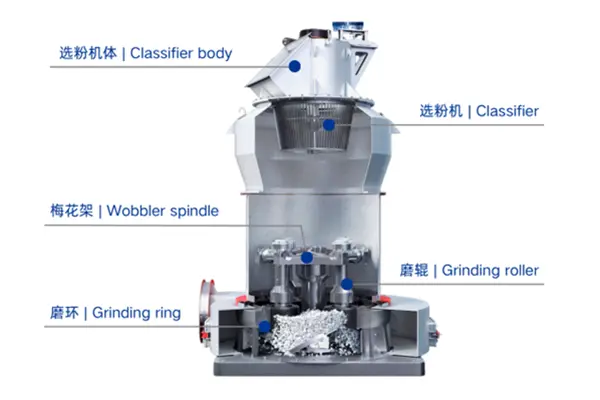
The ground powder is carried by the rising airflow from the fan to the classifier at the top for separation: qualified fine powder passes through the classifier wheel with the airflow into the collection system for gas-solid separation, while unqualified coarse particles are intercepted by the classifier blades and fall back to the grinding zone under gravity for regrinding, forming a closed-circuit cycle.
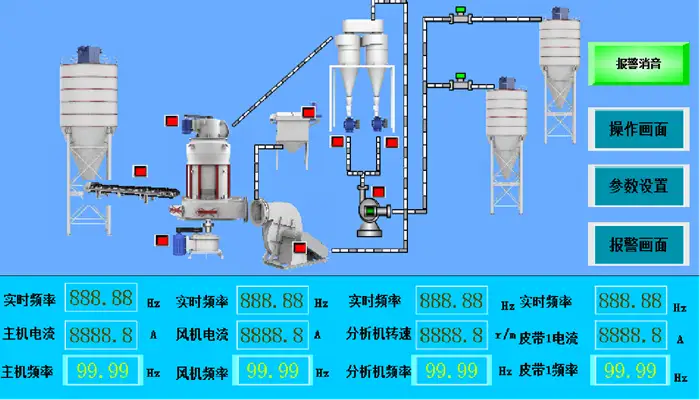
A PLC control cabinet with variable frequency drive adjusts classifier speed and system airflow: higher classifier speed produces finer powder, while lower speed produces coarser powder. Higher airflow allows more fine powder to pass through, increasing output; lower airflow retains fine powder in the main unit, reducing output.
Collection & Dust Removal
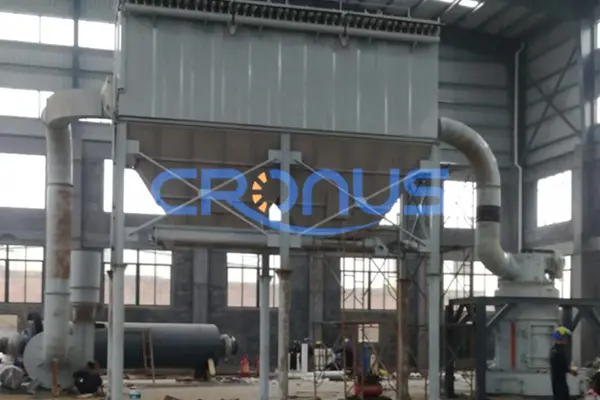
The collection system consists of a cyclone collector and a pulse jet baghouse dust collector. The cyclone collector serves as the primary collection device, collecting 80%~95% of finished fine powder (>10μm), while the pulse jet baghouse serves as the secondary collection and dust removal device, recovering residual dust (especially ultra-fine powder <10μm) and purifying exhaust gas. The total product recovery rate is high (>99.9%), emission concentration is low (≤10mg/m³), and purified gas is discharged by the fan.
Finished Product Packaging
The collected finished powder is discharged through a discharge valve, conveyed by conveying equipment to the finished product silo, and then measured and packed by an automatic packaging machine, or stored and transported in bulk form. If further value addition is required, equipment such as modifiers, granulators, or magnetic separators can be added for deep processing such as modification, shaping, and purification.
Raymond Mill Application Scenarios
Raymond Mill Technical Parameters
| CRRM Raymond Mill Parameter Comparison Table | ||||||||
| Model |
Feed Size (mm) |
Product Fineness (mesh) |
Capacity (t/h) |
Power (kW) |
Overall Dimensions (L*W*H) (mm) (Excluding Dust Collector) |
|||
| Main Unit | Fan | Classifier | ||||||
| 4R3220 | ≤20 | 80~400 | 1~6 | 45 | 45 | 15 | 6950×4570×8295 | |
| CRRM1280 | ≤20 | 1.5~10 | 55 | 55 | 15 | 8400×5650×8200 | ||
| 5R4128 | ≤20 | 2~15 | 90 | 90 | 22 | 8660×6050×9250 | ||
| CRRM1500 | ≤20 | 3~18 | 110 | 110 | 22 | 8700×5500×9250 | ||
| CRRM1620 | ≤30 | 5~22 | 160 | 132 | 30 | 9670×5570×10550 | ||
| CRRM1700 | ≤30 | 6~28 | 185 | 160 | 37 | 9670×5570×10550 | ||
| CRRM1850 | ≤30 | 6.5~30 | 200 | 200 | 37 | 10455×6830×9815 | ||
| CRRM1920 | ≤30 | 7.5~33 | 220 | 220 | 45 | 13312×7690×9815 | ||
| CRRM2150 | ≤30 | 10~40 | 250 | 280 | 45 | 11080×7600×11150 | ||
| CRRM2500 | ≤35 | 11.5~50 | 280 | 280 | 45 | 11480×7730×11250 | ||
| CRRM2750 | ≤35 | 15~80 | 450 | 450 | 75 | 17000×11000×15000 | ||
| * The above data is for reference only. Specific parameters vary depending on materials. | ||||||||
Frequently Asked Questions About Raymond Mills
How to choose the right Raymond mill?
Standard Condition: For conventional 80~400 mesh applications, a standard model is sufficient. The specific model and process configuration should be customized based on your actual operating conditions.
Small scale, space-constrained: Choose a small Raymond mill with a single-cyclone design, simple structure, small footprint, and low investment cost.
Large industrial projects: Choose a large Raymond mill with multiple grinding rollers (≥4) for high grinding efficiency, an integral base casting process for stable operation.
Temporary production lines: Choose a mobile Raymond mill mounted on an integrated base, requiring no concrete foundation. Ready for operation after lifting and placement, easy to install and flexible to relocate.
Heat-Sensitive Materials: For materials that become flammable at high temperatures, select an open-circuit Raymond mill with explosion-proof design. The material is quickly discharged in a single pass after grinding, without classification or recirculation. The equipment is equipped with safety devices such as anti-static filter bags, explosion relief valves, explosion-proof motors, and a nitrogen protection system to ensure safe production.
Other Conditions: For special materials (such as hydrated lime, silicon carbide) and special processes (simultaneous sand and powder production), customized Raymond mills are required. Examples include: an anti-stick designed hydrated lime grinding mill, a wear-reinforced silicon carbide grinding mill, and an integrated sand and powder grinding machine. For special customization needs, please contact us.
What scenarios are suitable for multiple Raymond mills in parallel?
Multiple units in parallel refer to operating two or more small to medium-sized Raymond mills simultaneously, achieving larger-scale production through quantity accumulation. The advantages are lower cost per unit, the ability to invest in stages, flexible startup/shutdown based on market demand to adjust capacity and product types, and the fact that maintenance downtime of one unit does not affect production of others. Disadvantages include larger footprint, slightly higher specific energy consumption, and more complex system layout. It is suitable for scenarios with limited investment, fluctuating production demand, the need for flexible product adjustment, and plant expansion projects.
Can a Raymond mill process coarse powder?
A Raymond mill cannot efficiently grind coarse powder below 80 mesh. When processing, the fan speed must be reduced, which causes material retention in the grinding chamber and affects production efficiency. Low-cost crushers are typically used for such applications.
Can a Raymond mill process ultra-fine powder?
It is generally not recommended to use a Raymond mill for ultra-fine powder above 400 mesh. When processing ultra-fine powder, energy consumption increases exponentially with fineness and capacity becomes limited. Ultra-fine grinding mills are generally recommended. If a Raymond mill has already been purchased, it can be equipped with an ultra-fine classifier to extend fineness to 600 mesh, but its high-efficiency grinding range remains around 400 mesh.
Can a Raymond mill process quartz?
It can process quartz, but it is not economical. A ball mill is generally recommended. Quartz has a Mohs hardness of 7, which is at the upper hardness limit of Raymond mills. During processing, wear of grinding rollers and rings is accelerated, leading to frequent replacement, increased downtime, and higher maintenance costs.
Does a 4R Raymond mill have 4 grinding rollers?
The "4" in 4R does not represent the number of grinding rollers. In the model designation, "R" stands for Roller, and the preceding number represents the equipment performance level. For example, the 4R3220 Raymond mill is a small to medium-sized Raymond mill with 3~4 grinding rollers.
How to Choose a Reliable Raymond Mill Manufacturer?
When selecting a Raymond mill, first evaluate grinding efficiency and fineness control, focusing on the material of the grinding rollers and rings as well as classifier precision. Second, consider operational stability and maintenance costs—long service life of wear parts is essential for continuous production. Finally, assess environmental compliance and automation level, ensuring the equipment meets national dust emission standards (≤30mg/m³). Based on these criteria, Cronus Machinery, ranked among China's top ten Raymond mill manufacturers, is a highly recommended choice. Its GK Raymond mill offers precise fineness control from 80 to 400 mesh, a 325 mesh passing rate of ≥95%, exhaust emissions ≤10mg/m³, and energy consumption 30%~40% lower than ball mills. The equipment is constructed with wear-resistant materials such as high manganese steel and alloy steel, and is equipped with an advanced PLC intelligent control system. With over 50 years of industry experience, it is a brand you can trust.
 Home
Home Products
 About
About Call
Call