

Why do the grinding roller shaft and the central shaft of a Raymond mill need to undergo heat treatm
- Time:2026-05-13
- Views:22
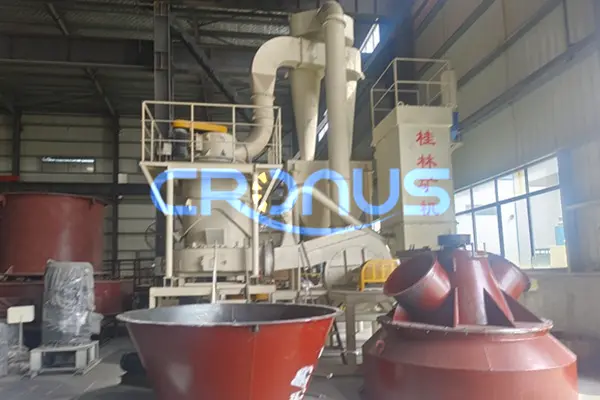
The heat treatment of the grinding roller shaft and the central shaft is a core process that determines the strength, service life, and overall operational stability of the Raymond mill. Only shafts that have undergone quenching and tempering heat treatment can meet the requirements for long-term, stable operation of the Raymond mill.
Working Principle AnalysisHidden Risks of Omitted Heat TreatmentActual Working Condition ApplicationStandard Processing Technology
In the procurement of Raymond mill accessories, the heat treatment of grinding roller shaft and central shaft is one of the most frequently consulted technical issues by customers. Many customers wonder why shafts with the same appearance differ in price by several times. The core reason lies in whether the standard quenching and tempering heat treatment process is implemented.
Working Principle Analysis of Heat Treatment for Raymond Mill Shaft Parts
Standard Raymond mill shaft parts adopt the quenching and tempering process of integral quenching plus high-temperature tempering. By changing the internal metallographic structure of steel, it achieves an optimal balance of strength, toughness, wear resistance and dimensional stability.
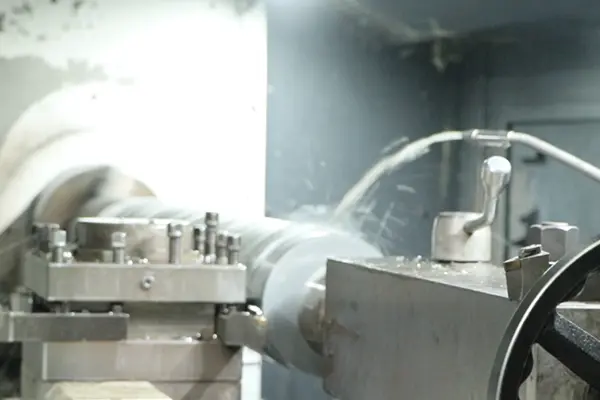
During integral quenching, the rough turned shaft is heated above the critical temperature (approx. 840℃ for 45# steel and 860℃ for 40Cr steel), then quickly cooled in water after heat preservation, forming a high-hardness internal structure to enhance the strength and hardness of the shaft.
Subsequently, high-temperature tempering is carried out at 500~650℃ to eliminate the high brittleness caused by quenching. The internal metallographic structure integrates high strength, high toughness and good wear resistance, meeting the stringent requirements for long-term stable operation of Raymond mills.
| Advantages of Raymond Mill Shaft Parts after Heat Treatment | |||
| Bending Strength | Impact Resistance | Wear Resistance | Structural Stability |
| Increased by 30%~50%, preventing bending deformation under heavy load | Greatly improved to resist instantaneous impact during grinding operation | Wear resistance of bearing position and oil seal position increased by more than 2 times, avoiding bearing inner ring runout and oil seal failure | Greatly improved dimensional stability with permanent concentricity in long-term operation |
Impact of Omitting Heat Treatment on Raymond Mill
To reduce production cost and shorten manufacturing cycle, some manufacturers sell shafts directly turned from round steel without heat treatment. Although identical in appearance to qualified products, such unprocessed shafts have severe performance hidden dangers and cause heavy economic losses to users: insufficient strength leads to bending deformation, poor wear resistance causes rapid abrasion at bearing positions, and unstable dimension results in concentricity deviation, eventually bringing frequent shutdown and maintenance of Raymond mills.
Necessity of Heat Treatment Combined with Actual Working Conditions of Raymond Mill
Raymond mill shaft parts bear complex and variable working loads for a long time. Only through standard quenching and tempering heat treatment can the long-term stable operation of the equipment be guaranteed.
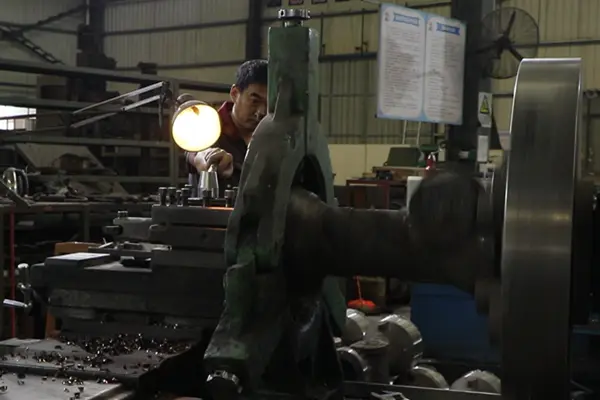
Grinding Roller Shaft: Key Component with Complex Stress
Installed inside the grinding roller assembly, the grinding roller shaft revolves with the plum blossom frame and drives the grinding roller to rotate simultaneously. During grinding operation, it bears huge outward swinging force, material impact force and alternating cyclic load.
Under such complex stress conditions, the grinding roller shaft must integrate high impact resistance, strong bending resistance, excellent wear resistance at bearing positions and stable dimensional performance, all of which can only be achieved by professional heat treatment.
Central Shaft: Core Load-bearing and Transmission Component
Located at the exact center of the Raymond mill main unit, the central shaft bears the total weight of the grinding roller assembly and plum blossom frame, and transmits motor torque to ensure the concentricity of the entire grinding system. It is mainly subjected to torsional moment, radial bending moment and alternating fatigue load, rather than simple compressive load.
Slight bending or bearing position wear of the central shaft will trigger a chain reaction including complete machine eccentricity, severe vibration and uneven wear of grinding roller and ring. Therefore, the central shaft must feature high strength, fatigue resistance and dimensional stability, which are inseparable from standard heat treatment process.
Manufacturing Standard of Raymond Mill Shaft Parts by Cronus Machinery
Cronus Machinery always adheres to the production principle of no omitted processes, no fake materials and no reduced heat treatment procedures. We adopt national standard high manganese steel, alloy steel and other wear-resistant materials to guarantee product quality from the source.
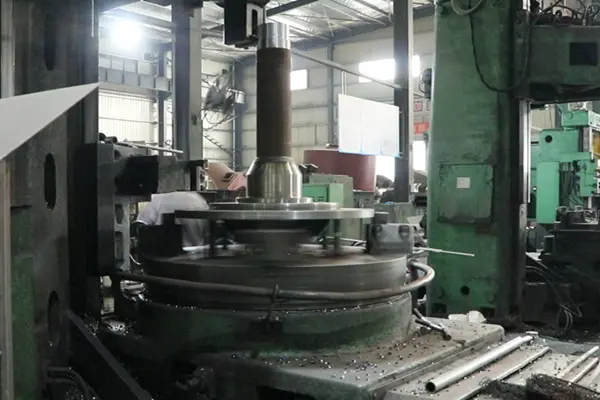
The production strictly follows the standard technological process: Rough Turning - Heat Treatment - Semi-finish Turning - Precision Grinding.
Blanking: Adopt high-quality round steel for precise blanking according to drawing dimensions, with sufficient machining allowance and heat treatment deformation allowance reserved.
Rough Turning: Process the blank into shaft semi-finished products by rough turning to remove excess base material.
Heat Treatment: Conduct integral quenching and high-temperature tempering (quenching and tempering) on rough turned shaft blanks, the core procedure of shaft production.
Semi-finish Turning: Remove surface oxide scale and correct micro deformation caused by heat treatment after thermal processing.
Precision Grinding: Perform finish machining and precision grinding on bearing positions and oil seal positions to strictly ensure surface roughness and assembly dimensional accuracy.
Inspection: Check key performance indicators such as concentricity, circular runout and hardness item by item to meet design requirements. Qualified products will be stored after rust prevention treatment.
Special quality inspectors are assigned for each process. Hardness sampling inspection and three-coordinate concentricity test are implemented for every shaft before delivery, ensuring all key indicators meet industry standards.
- Previous Article:How to construct a standard foundation for a Raymond Mill?
- Next Article:Can a Raymond mill grind multiple materials together?
- Can Sand‑Powder Integrated Machines Truly Achieve Co‑production? Equipment Selection Guide
- Deep‑Dive Analysis of Working Principle of Raymond Mill
- European Version, German Version, Vertical Swing Type Grinding Mills: Genuine Upgrade or Fake Concep
- Comparative Analysis of Inverted Cone Rotor and Cylindrical Rotor for Raymond Mill
 Home
Home Products
 About
About Call
Call