

Comparative Analysis of Inverted Cone Rotor and Cylindrical Rotor for Raymond Mill
- Time:2026-05-08
- Views:20
The cylindrical rotor for Raymond mill is not a complete replacement for the traditional inverted cone rotor, but a dedicated technical upgrade for working conditions requiring medium-low mesh and high output.The inverted cone rotor is still the most widely adopted mainstream solution in the Raymond mill industry.
What Is Raymond Mill RotorFineness Control ComparisonAdvantages of Cylindrical RotorRotor Selection Recommendation
What is Raymond Mill Rotor?
The classifier of Raymond mill is mainly composed of rotor and blades. As the core component that controls finished powder fineness, the rotor structure directly determines classification precision, classification efficiency and overall output. As a professional Raymond mill manufacturer, we have adopted the classic inverted cone rotor as the industry standard configuration for more than 40 years. In recent years, aiming at the industry pain point that traditional Raymond mills cannot balance fineness and output, we have developed and promoted cylindrical widened blade rotors, providing an efficient matching solution for large-scale powder production projects with medium-low mesh and high output requirements.
Inverted Cone Rotor
The inverted cone rotor is a mature structure verified by long-term industrial application. The diameter of the upper disc is 15%~25% larger than that of the lower disc, forming an integral inverted cone shape. Blades are evenly and radially distributed along the conical surface with a conventional width of 80~120mm and a mounting angle of 15°~20°. Verified by long-term industrial practice, this structure has become a universal classic design adopted by many powder mill manufacturers and widely used in various models of Raymond mills.
Cylindrical Rotor
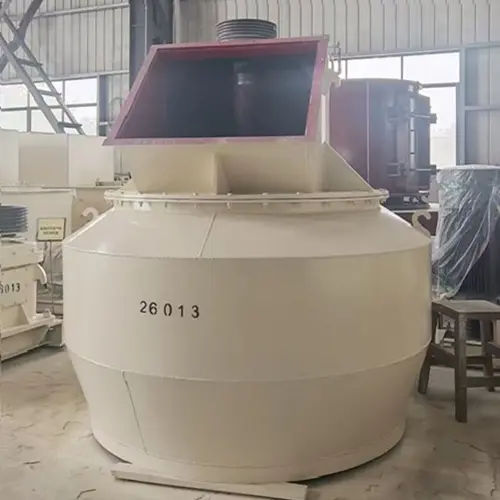
The cylindrical widened blade rotor is an improved design gradually promoted by us after 2020. The diameter difference between upper and lower discs is ≤5% (basically the same), presenting an overall cylindrical shape. The core improvement is to increase the blade width to 150~220mm, and optimize the blade mounting angle to 10°~15° to reduce air flow resistance, which is not a simple shape modification.
Fineness Control Comparison Between Inverted Cone and Cylindrical Rotor of Raymond Mill
The core working principle of Raymond mill classifier is to generate centrifugal force through rotor rotation to separate qualified fine powder from coarse particles. The classification differences between the two rotors are mainly reflected in centrifugal force distribution, air flow path and particle interception efficiency.
Inverted Cone Rotor, Precise Fineness Control
When the inverted cone rotor rotates, according to the linear velocity formula v=ωr, the upper radius is larger, and the centrifugal force increases linearly from bottom to top (the upper centrifugal force is about 1.2~1.5 times of the lower part), forming a natural gradient classification zone.
Low Centrifugal Force Zone at Lower Part: Pre-intercept most coarse particles larger than 100μm, preventing them from entering the upper high classification zone and interfering with fine powder separation.
High Centrifugal Force Zone at Upper Part: Achieve precise classification for 200-400 mesh (75-38μm) powder with clear classification boundary, and the fineness fluctuation range can be controlled within ±5μm.
Limitations: Excessively high linear velocity at the upper part will cause part of qualified fine powder to be intercepted and returned excessively, resulting in over-grinding and reducing energy utilization efficiency.
Cylindrical Rotor, Higher Sieve Passing Rate
The core advantages of the cylindrical rotor lie in uniform centrifugal force distribution and enhanced physical interception capacity. Meanwhile, it extends the residence time of powder in the classification zone (about 30% longer than traditional inverted cone rotor), allowing sufficient time for separation of coarse and fine particles.
Uniform Centrifugal Force Distribution: Avoid excessive classification at the upper part and insufficient classification at the lower part of inverted cone rotor, increasing classification efficiency (qualified fine powder passing rate) by 10%~15%.
Widened Blade Interception: Increase contact area with powder air flow, effectively block unqualified fine powder from passing through, and reduce oversize particles (more than 20μm above target mesh) by more than 60%.
Improved Fineness Stability: Under the same conditions, the qualified rate of finished powder fineness is increased from 85%~90% of traditional inverted cone rotor to 92%~95%.
Advantages of Cylindrical Rotor for Raymond Mill
In the Raymond mill system, classifier speed is positively correlated with fineness and negatively correlated with output. The higher the speed, the greater the centrifugal force and the stronger the fine powder interception capacity, resulting in finer finished fineness, but the return of coarse particles increases and the overall output decreases. Conversely, reducing the speed can increase output yet easily lead to unqualified fineness.
<
Through structural optimization, the cylindrical widened blade rotor realizes balanced adaptation of reducing speed, maintaining fineness and increasing output. Relying on the physical interception of widened blades, it can replace part of the centrifugal classification effect, and still stably guarantee finished fineness at a lower speed than inverted cone rotor. Taking 325 mesh calcium carbonate production as an example, the speed of cylindrical rotor can be controlled at 140~160rpm, 20%~30% lower than that of inverted cone rotor.
After speed reduction, the air flow resistance of the rotor is reduced by about 25%, the material circulation inside the grinding chamber is smoother. With the same configuration, the output can be increased by 8%~15%, and the comprehensive energy consumption is reduced by 5%~10%. Meanwhile, it reduces the load on rotor bearings and transmission system, extending the service life of wearing parts by more than 20%.
The traditional inverted cone rotor relies entirely on centrifugal force for classification, with a strong linear correlation between fineness and speed, making it impossible to increase output by reducing speed while ensuring fineness.
Selection Recommendation for Raymond Mill Classifier Rotor
As a targeted optimized structure, the cylindrical rotor is suitable for working conditions pursuing output improvement and high fineness qualification rate. It is especially suitable for large-scale powder production of medium-low mesh wood-plastic powder. As an effective upgrade to the traditional structure, it can realize dual optimization of output and energy consumption while ensuring fineness qualification rate.
With mature and stable high-fineness classification performance, the inverted cone rotor is still the mainstream solution for 80~400 mesh medium and fine powder processing in the market. Meanwhile, it holds an irreplaceable application advantage in high-fineness and high-precision special material powder processing scenarios.
| Inverted Cone Rotor | Cylindrical Rotor |
| Suitable for 80~400 mesh, optimal for 200~400 mesh high fineness | Suitable for 80~325 mesh, focusing on 100~200 mesh medium-low fineness |
| Fineness control accuracy ±5μm | Fineness control accuracy ±8μm |
| Relatively lower output | Output increased by 8%~15% vs inverted cone rotor |
| Precise fineness control, uniform particle size | High sieve passing rate, few oversize particles, obvious mass production advantages |
 Home
Home Products
 About
About Call
Call