

Comparative Analysis of Suspension Type and Vertical Swing Type Raymond Mills
- Time:2026-04-30
- Views:33
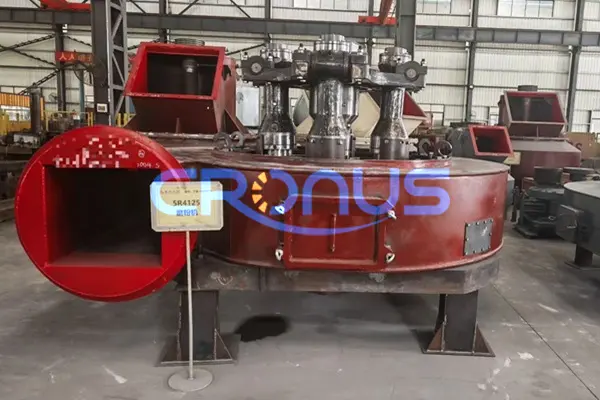
The difference between the suspension type and the vertical swing type Raymond mills lies in the suspension structure of the roller assembly and the direction of the swing axis. The vertical swing type optimizes the negative swing angle defect of the suspension type, but its later maintenance and operation costs are significantly higher than those of the suspension type structure.
Suspension Type Raymond MillVertical Swing Type Raymond MillStructural Comparison AnalysisCurrent Market Analysis
Suspension Type Raymond Mill Introduction
The suspension type Raymond mill originated from the classic suspension structure design first introduced in 1906. After a century of technological iteration, its technical system has matured and its operation is stable. It is the most widely applied and largest installed capacity general-purpose equipment in the global non-metallic mineral processing field. In the 80~400 mesh powder processing market, its share has long been stable at over 60%.
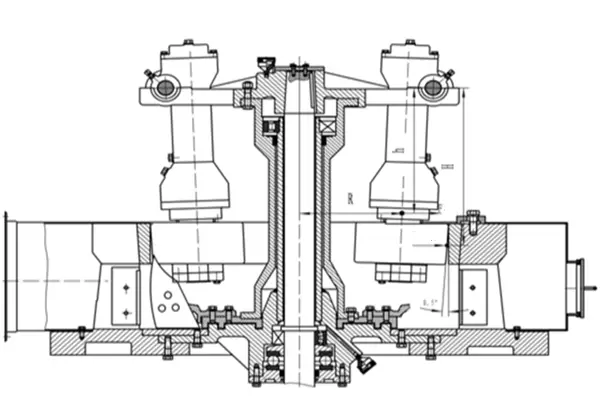
Roller Assembly: Horizontally suspended on the quincunx frame via a crossbeam shaft. Rubber sleeves connect both ends of the shaft to the frame, providing both cushioning and vibration absorption as well as limited radial swing.
Roller Sleeve Structure: Single-shell integrated design. The roller shaft and roller body are installed inside the shell using upper and lower sets of tapered roller bearings. Features few components, low processing and assembly difficulty, and strong parts commonality.
Swing Characteristics: The roller swings outward and inclinedly around the horizontal crossbeam shaft. During operation, the angle between the roller axis and the main shaft axis remains fixed, resulting in a negative swing angle of approximately 0.5° (roller center offset relative to the grinding ring center is about 5mm).
Bearing Load: Bearings are subjected to both radial and axial loads, distributed unevenly. The lower bearing bears approximately 70% of the total grinding force, making it prone to localized accelerated wear over long-term operation.
Working Principle: The main motor drives the quincunx frame to rotate, causing the suspended roller assembly to revolve with the frame while the roller itself rotates. Under centrifugal force, the roller tilts outward and presses against the grinding ring, concentrating the grinding force on a narrow contact line, which decreases gradually from the bottom to the top of the roller, resulting in uneven grinding force distribution. Centrifugal force cannot be fully converted into grinding force, leading to energy loss (Grinding force = Centrifugal force × h/H, where h/H ≈ 0.8).
Vertical Swing Type Raymond Mill Introduction
The vertical swing type Raymond mill emerged in the early 21st century, primarily designed to overcome the limitations of the negative swing angle found in the suspension type. It achieves more uniform wear of the grinding rollers and rings, extending their service life by 1 to 1.5 times compared to the suspension type. However, its swing joints and sealing system are subjected to complex forces, leading to prominent wear and aging issues, significantly higher maintenance costs than the suspension type, and currently no perfect solution exists that balances low cost with high reliability.
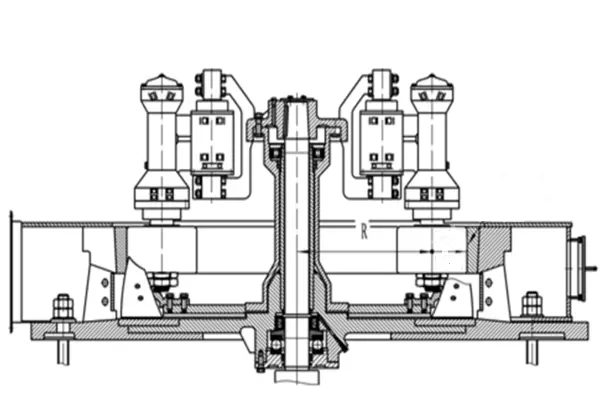
Roller Assembly: Vertically installed on the quincunx frame via a vertical swing shaft. Both ends of the vertical swing shaft are rigidly fixed to the frame, offering better structural stability than the suspension type's flexible suspension, but with more linkage components.
Roller Sleeve Structure: Parallel dual-shell design. The right shell houses the roller shaft and roller body, while the left shell is loosely fitted over the vertical swing shaft, forming an independent swing joint. This requires higher machining and assembly precision than the suspension type's single-shell structure.
Swing Characteristics: The roller swings outward and parallelly around the vertical swing shaft. During operation, the roller axis remains strictly parallel to the main shaft axis, with no negative swing angle, enabling full surface contact between the roller and the grinding ring.
Bearing Load: Bearings primarily experience pure radial loads, which are uniformly distributed across all bearing race surfaces without additional axial force, theoretically leading to more even bearing wear. However, the sealing system is subjected to more complex forces due to the swinging structure.
Working Principle: Under centrifugal force, the roller swings outward parallel to the main shaft, creating full, parallel surface contact between the entire cylindrical surface of the roller and the grinding ring. The grinding force is uniformly distributed across the entire contact surface, with unit area pressure 25%~30% higher than the suspension type. Centrifugal force is fully converted into grinding force (Grinding force = Centrifugal force), offering superior grinding efficiency. However, long-term high-frequency, small-angle swings (0~10°) continuously stress the swing joints and sealing system, making them prone to wear and aging.
Structural Comparison: Suspension Type vs. Vertical Swing Type Raymond Mill
| Suspension Type Raymond Mill | Vertical Swing Type Raymond Mill |
| Single-shell integrated, simple structure, low precision requirements | Parallel dual-shell, complex process, high precision requirements |
| Inclined line contact, with negative swing angle | Parallel surface contact, no negative swing angle |
| Grinding force reduced by ~20%, slightly higher specific power consumption | No grinding force reduction, 15%~25% lower specific power consumption |
| Uneven wear of rollers/rings, slightly higher replacement frequency | Even wear of rollers/rings, 1~1.5 times longer service life |
| Low initial investment, common and easily available parts | High procurement cost, expensive proprietary seals and swing joint parts |
| No high-frequency swing joints, reliable sealing, can run 24/7 | Dynamic sealing weakness, swing joints prone to loosening, rapid stability decline over time |
| Bearing service life: 8,000~10,000 hours | Bearing service life: 5,000~7,000 hours |
| Simple operation, short maintenance downtime | Difficult repair, long downtime |
Why Has the Vertical Swing Type Raymond Mill Failed to Become Mainstream?
Although the vertical swing type Raymond mill offers theoretical improvements in grinding efficiency and capacity over the suspension type, its complex swinging structure introduces difficult-to-solve high-frequency dynamic sealing problems. This leads to high maintenance costs and far inferior operational stability compared to the suspension type.
Its core defect stems from the fundamental contradiction between its structure and operating environment: the precision swing joints, designed for high-efficiency grinding, inevitably face rapid seal failure in high-dust environments. Once rubber seals age, fine dust particles invade the bearing housing, leading to frequent bearing failure. The high cost of repair and disassembly far outweighs any electricity savings from the theoretical efficiency gains.
Furthermore, the complex quincunx frame and joint structure demand highly skilled maintenance personnel, beyond the capability of ordinary mechanics. While many users acknowledge its high output, their resolve crumbles after repeated bearing failures ("mental breakdown"). Unable or unwilling to afford repairs, these units often end up in the second-hand market, where their low resale value is compounded by buyer skepticism, whose first reactions are often "seals are prone to failure" and "bearings are likely seized."
While the suspension type suffers from reduced grinding force due to its negative swing angle, its extremely simple structure, absence of high-frequency swing joints, reliable sealing, and convenient maintenance result in the lowest total lifecycle cost. For 80~400 mesh conventional powder processing, the suspension type reliably meets the production needs of the vast majority of users. Its mature technology, low failure rate, and common, easily sourced parts make it easily adaptable for small-to-medium enterprises and multi-material processing scenarios.
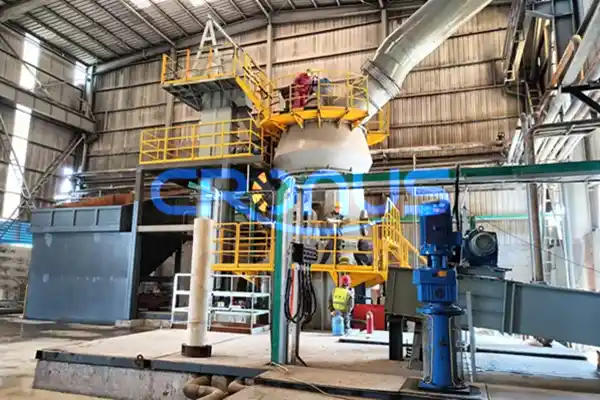
For large-scale production demanding long-term stability and low maintenance costs, the industry increasingly favors vertical roller mills. Although the initial investment for a vertical mill is higher than for the vertical swing type, its downstream operating and maintenance costs are lower. It offers a high return on investment for large-scale continuous production and superior powder uniformity.
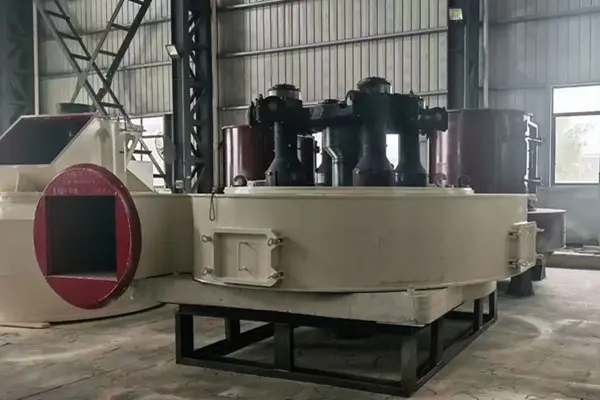
Backed by over half a century of technological accumulation, Cronus machinery has always adhered to the core design philosophy of being "practical, reliable, and economical." Rather than blindly pursuing theoretical improvements in parameters, it remains committed to mature solutions that have been long validated by the market. This is one of the key reasons why the CRRM Raymond mill continues to use the pendulum-type roller assembly. This design has not only earned long-term customer acclaim but has also resulted in an almost zero circulation rate of the equipment in the second-hand market.
- Previous Article:Comparative Analysis of Inverted Cone Rotor and Cylindrical Rotor for Raymond Mill
- Next Article:Limestone Grinding Mill Selection Guide
 Home
Home Products
 About
About Call
Call