

How to select the matching feeder for a Raymond mill?
- Time:2026-03-27
- Views:42
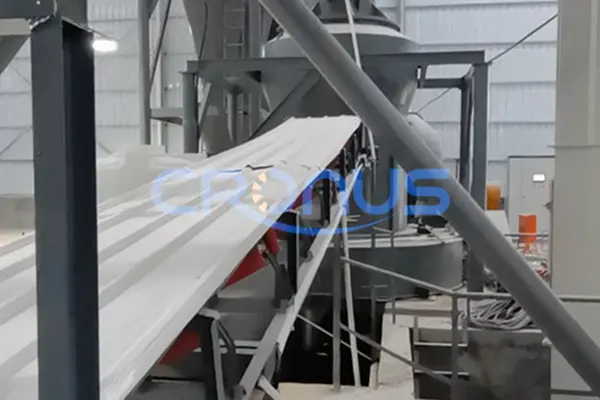
The vibrating feeder is suitable for conveying granular and lump materials; the belt feeder is suitable for conveying granular, powdery, and lump materials; and the screw feeder is suitable for conveying powdery and small granular materials. For large lump materials and high-moisture materials, the use of a screw feeder is strictly prohibited.
FunctionsCommon TypesSelection GuideCommon Mistakes to Avoid
Role of Feeder in Raymond Mill System
In the grinding production line, the feeder is a key piece of equipment connecting the crusher and the Raymond mill. Its function is to feed the crushed material into the Raymond mill main unit in a uniform, continuous, and controllable manner.
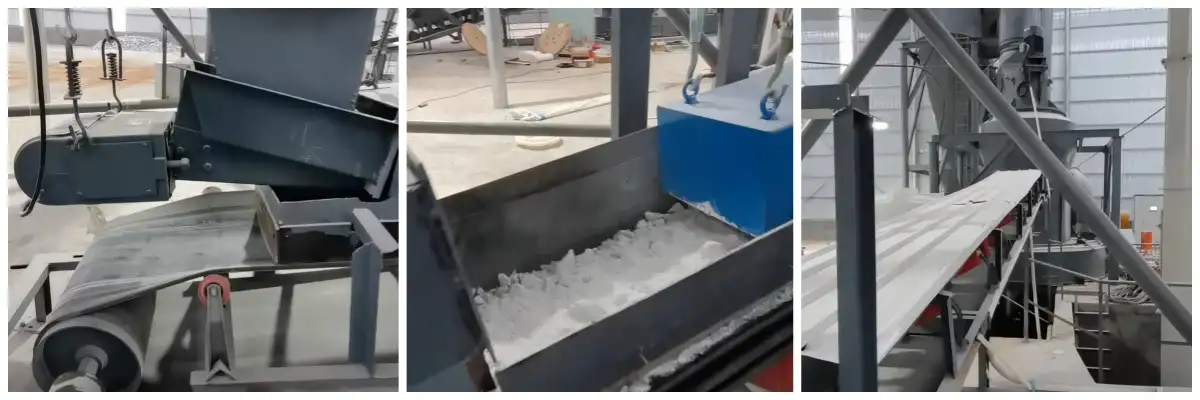
The stability of the feeding system determines the production efficiency of the Raymond mill. Insufficient feeding causes direct contact between the grinding roller and the grinding ring, accelerating wear and even leading to equipment failure. Excessive feeding results in a surge in main unit current, air duct blockage, and fluctuation in finished product fineness. Therefore, selecting the appropriate matching feeder is crucial to ensuring efficient and stable operation of the Raymond mill.
Common Types of Feeders for Raymond Mill
In Raymond mill system applications, the common types of feeders include vibrating feeders, belt feeders, and screw feeders.
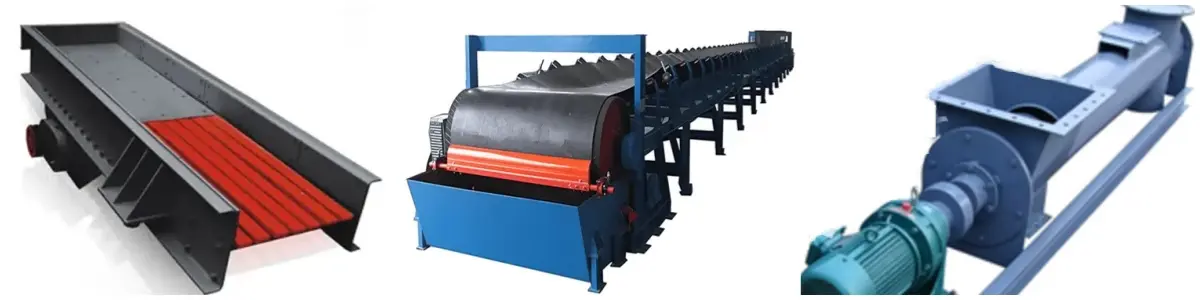
Vibrating Feeder (Left), Belt Feeder (Middle), Screw Feeder (Right)
| Comparative Analysis of Common Feeders for Raymond Mill | ||
|
Vibrating Feeder |
Belt Feeder | Screw Feeder |
| Uses an excitation source (electromagnet or motor) to generate high-frequency vibration, conveying material uniformly and continuously | Motor drives belt pulley for cyclic operation, achieving continuous material conveying | Motor drives screw blade rotation, pushing material for continuous conveying |
| Uniform feeding, sensitive adjustment, simple and low power consumption | Long-distance conveying, stable feeding, strong impact resistance | Compact structure, good sealing, capable of vertical conveying |
| Not suitable for sticky and wet materials (prone to clogging) | Large footprint, belt susceptible to wear | Not suitable for large lumps or high-moisture materials |
| Suitable for granular and lump materials (5–100 mm) | Suitable for granular, powdery, and lump materials (0–100 mm) | Suitable for powdery and small granular materials (<10 mm) |
Selection Recommendations for Raymond Mill Feeders
Material Moisture Content
Dry Materials (moisture content <5%): Choose a vibrating feeder. It features no rotating parts, no material retention zone, high feeding accuracy, and easy integration with automated control systems.
Sticky & Wet Materials (moisture content 5%~10%): Prioritize a belt feeder. The belt surface does not easily accumulate or clog, offering higher tolerance to moisture. For special conditions, a vibrating feeder with an increased trough inclination (typically 10°~15°) can be used.
High-Moisture Materials (moisture content >10%): Select a belt feeder. Do not use a screw feeder for high-moisture materials, as clogging between the screw blade and trough is likely to occur.
Material Particle Size
Large Lumps (>50 mm): Use a vibrating feeder (motor-driven) or a belt feeder. Both have strong conveying capacity and can withstand impact from large lumps.
Granular Materials (<10 mm): Prioritize a vibrating feeder for uniform feeding and precise control. For vertical applications, a screw feeder may be selected.
Powdery Materials: Choose a screw feeder for its good sealing properties, effectively preventing dust leakage.
Feeding Accuracy
Continuous Feeding: The feeding standard for Raymond mills is uniform and continuous feeding. An electromagnetic vibrating feeder is typically used, paired with variable frequency control to automatically adjust the feed rate, preventing mill overload or idle operation.
Dosing (Metered Feeding): For applications requiring measured feed rates, a belt feeder is typically selected, controlled by a variable frequency drive paired with a belt scale. This offers high control accuracy, enabling integrated continuous metering and feeding.
Precision Feeding: For chemical raw material grinding requiring precise ratio control, a screw feeder with a belt scale is recommended. The screw feeder handles sealed conveying and precise metering of powders, working with the belt scale to achieve feeding accuracy within ±0.5%.
High-Capacity Feeding: For large Raymond mill production lines with a single-unit capacity exceeding 10 t/h, a transfer bin is typically installed between the crusher and the Raymond mill. A vibrating feeder or belt feeder is usually placed below the bin, with the specific selection based on material characteristics and site layout.
Avoidance Guide for Raymond Mill Feeders
Directly Using a Vibrating Feeder for High-Moisture Materials
This involves feeding clayey limestone or kaolin with moisture content exceeding 8% directly into a vibrating feeder. The consequence is material adhesion and caking on the trough, leading to discontinuous feeding or feeding stoppage, frequent idle operation of the Raymond mill, and reduced output.
The correct approach is to use a belt feeder or equip a drying system to dry the material before feeding, ensuring the moisture content of the mill feed is <6%.
Using a Screw Feeder for Large Lump Materials
This involves feeding material with a particle size >20 mm into a screw feeder. The consequence is material becoming wedged between the screw blade and trough, causing motor overload, blade deformation or fracture, and in severe cases, motor burnout.
The correct approach is to switch to a vibrating feeder or belt feeder.
Feeder Capacity Mismatch with Raymond Mill Throughput
This refers to the feeder's maximum capacity being significantly higher or lower than the Raymond mill's design throughput. The consequence is uneven feeding, preventing the Raymond mill from operating efficiently. Excessive feeding capacity can overload the main unit, while insufficient capacity leads to frequent idle operation.
The correct approach is to properly match capacities, with the feeder's handling capacity set at 1.1 to 1.2 times the Raymond mill's throughput.
Neglecting Feed Inlet Sealing During Feeder Installation
This occurs when a flexible connection seal is not used between the feeder outlet and the Raymond mill inlet, or when the sealing device is aged and damaged. The consequence is air leakage at the feed inlet, reducing finished product collection efficiency and causing dust spillage.
The correct approach is to use a flexible sealing device (such as a canvas soft connection or silicone soft joint) between the feeder outlet and the Raymond mill inlet, and regularly inspect the integrity of the seal.
- Previous Article:What is an superfine grinding mill?
- Next Article:How to Select a Supporting Crusher for a Raymond Mill?
- Can Sand‑Powder Integrated Machines Truly Achieve Co‑production? Equipment Selection Guide
- Deep‑Dive Analysis of Working Principle of Raymond Mill
- European Version, German Version, Vertical Swing Type Grinding Mills: Genuine Upgrade or Fake Concep
- Comparative Analysis of Inverted Cone Rotor and Cylindrical Rotor for Raymond Mill
 Home
Home Products
 About
About Call
Call