

How to Select a Supporting Crusher for a Raymond Mill?
- Time:2026-03-20
- Views:77
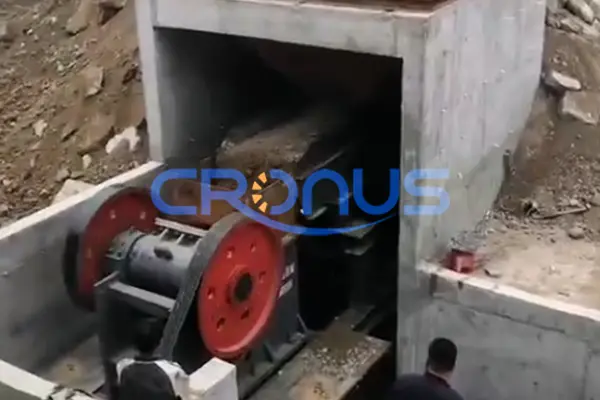
Jaw crusher is mainly used for primary crushing; impact crusher, hammer crusher and cone crusher are commonly used for secondary crushing; tertiary crushing mainly uses cone crusher and sand making machine. For high-moisture materials, select jaw crusher; for high-hardness materials, select cone crusher; for particle shape optimization, select impact crusher and sand making machine.
FunctionsCommon TypesSelection GuideCommon Mistakes to Avoid
Role of Crusher in Raymond Mill System
In a grinding production line, the crusher serves as the upstream preprocessing equipment for the Raymond mill. Its function is to reduce large feed material to a particle size that meets the Raymond mill feed requirement (≤30 mm), thereby reducing the load on the subsequent grinding process and improving production efficiency. Uniformly crushed feed also contributes to higher finished powder quality. Improper crusher selection may result in excessive feed particle size, accelerating wear of grinding components such as the grinding roller and grinding ring. Unsuitable feed size directly affects the grinding efficiency of the Raymond mill and causes fluctuations in product quality. Therefore, scientific selection of crushers based on material characteristics is the primary step for efficient and stable operation of the Raymond mill.
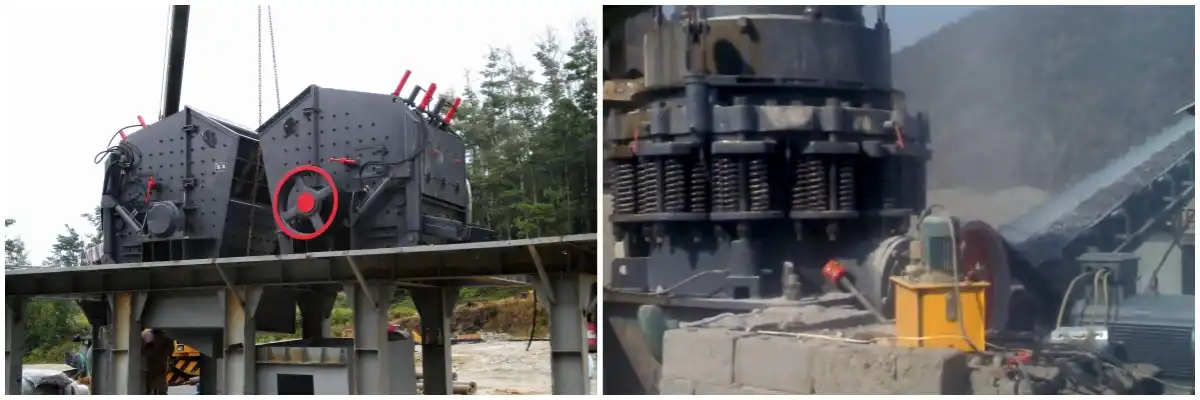
In the preprocessing crushing stage, the crushing process can be divided into primary crushing, secondary crushing, and tertiary crushing to process materials of different hardness levels and meet the feed size requirement of the Raymond mill.
| Role of Crusher in Raymond Mill System | ||
| Primary Crushing | Secondary Crushing | Tertiary Crushing |
| Jaw crusher is mainly used for crushing large lump ores. | Impact crusher, hammer crusher, or cone crusher can be used for further crushing of primary crushed material. | Cone crusher and sand making machine are mainly used for further tertiary crushing and shaping of secondary crushed material. |
Common Types of Supporting Crushers for Raymond Mill
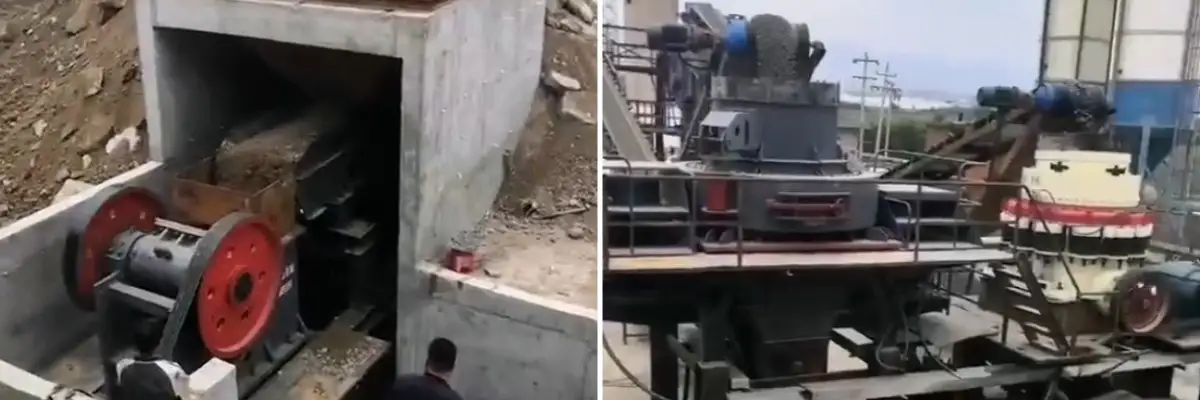
Common crusher types used in Raymond mill systems include jaw crusher, impact crusher, hammer crusher, and cone crusher.
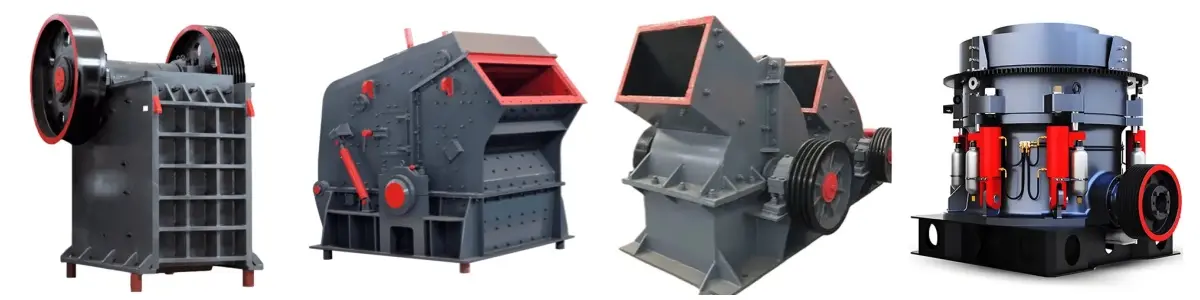
From left to right: jaw crusher, impact crusher, hammer crusher, cone crusher
| Comparative Analysis of Common Supporting Crushers for Raymond Mill | |||
| Jaw Crusher | Impact Crusher | Hammer Crusher | Cone Crusher |
| Compression crushing, moving jaw compresses fixed jaw. | Impact crushing, blow bars strike the impact plates. | Impact and shear crushing, hammers strike the grate plates. | Compression and attrition crushing, moving cone compresses fixed cone. |
| Mainly used for primary crushing. | Mainly used for secondary crushing. | Mainly used for secondary and tertiary crushing. | Mainly used for secondary and tertiary crushing. |
| Handles materials of various hardness levels. | Handles low to medium hardness materials. | Handles low to medium hardness materials. | Ideal for high hardness materials. |
| Good wear resistance, relatively low cost. | High reduction ratio, excellent product particle shape. | Very high reduction ratio, low initial investment. | High wear resistance, good product particle shape. |
Crusher Selection Guide for Raymond Mill
Material Hardness
High Hardness Materials: For materials such as granite, basalt, iron ore, and river pebbles with Mohs hardness >7, a jaw crusher is required for primary crushing to utilize its high compressive force for breaking large lumps. For secondary and tertiary crushing, a cone crusher is recommended. Cone crushers are currently the most cost-effective solution for secondary and tertiary crushing of high hardness materials, employing the laminated crushing principle to break hard rock through compression and attrition. The wear parts (mantle and concave) have a significantly longer service life than hammers and blow bars. Although the initial investment is higher, the long-term operating cost and stability advantages are significant.
Low to Medium Hardness Materials: For materials such as limestone, calcite, and dolomite with Mohs hardness ≤7, a jaw crusher is typically used for primary crushing. For secondary crushing, a hammer crusher or impact crusher is primarily used. Heavy-duty hammer crushers can even achieve both secondary and tertiary crushing in a single stage, effectively simplifying the process. Note that while hammer crushers are suitable for such soft rock, they are not suitable for materials with excessive moisture content (exceeding 8% to 10%). For tertiary crushing, a hammer crusher or fine jaw crusher (PEX type) can be selected based on actual requirements to ensure the feed size meets the mill requirements.
Material Moisture
Jaw crushers offer the strongest adaptability and the highest tolerance for materials with high moisture and high clay content. Hammer crushers, due to the grate at the bottom, are prone to grate hole blockage under high moisture conditions, which also accelerates wear on the hammers and grate. Impact crushers, while not having the grate blockage issue, are still sensitive to high clay content (clay tends to coat the crushing cavity), and when moisture is excessively high (exceeding 10% to 12%), crushing efficiency is significantly reduced. Cone crushers are highly sensitive to sticky and wet materials, prone to blockage, and should be avoided for processing materials with high moisture or high clay content.
Process Configuration
Non-Metallic Mineral Processing: Single-stage crushing is predominant. If the run-of-mine particle size is not particularly large, a single jaw crusher can reduce the material to the feed size required by the Raymond mill (typically ≤30 mm).
Metallic Ore Processing: The principle of "more crushing and less grinding" is followed, employing multi-stage crushing. Primary crushing uses a jaw crusher to reduce material to 200-300 mm. Secondary crushing uses a cone crusher or impact crusher to reduce material to 50-100 mm. Tertiary crushing uses a cone crusher to reduce material to ≤30 mm, thereby minimizing the feed size to the mill and ensuring efficient and stable operation of the Raymond mill.
Industrial Solid Waste Processing: For uniformly sized materials such as slag and fly ash, a crusher is typically not required. For lump materials such as ceramic waste and steel slag, a two-stage crushing process consisting of a jaw crusher and an impact crusher is typically used to liberate the material to the standard feed size required by the Raymond mill. (Note: If the steel slag has high hardness or iron content, a fine jaw crusher or hammer crusher may be considered for tertiary crushing to reduce wear costs.)
Chemical Raw Material Processing: Specialized crushers with stainless steel or ceramic liner materials are required, equipped with a vibrating screen to form a closed-circuit crushing system. This prevents iron contamination of the raw material, ensuring the purity of the finished powder from the source.
Product Particle Shape
If strict requirements exist for the product particle shape, an impact crusher can be selected. Impact crushers produce finished products with a predominantly cubic shape and very low flakiness content (≤10%), making them suitable for limestone sand making, construction waste recycling, and other low to medium hardness materials. If the highest standard of particle shape is required, a sand making machine (vertical shaft impact crusher) using the "rock-on-rock" principle can be selected, which yields the best particle shape. For hard rock processing (e.g., metallic ores, granite), where wear reduction is the primary concern, a cone crusher (especially the hydraulic type) is recommended. Although the particle shape is slightly inferior (flakiness content of 12% to 15%), the laminated crushing principle ensures longer wear part life.
Common Mistakes to Avoid for Crusher in Raymond Mill System
Attempting to Process Hard Rock with a Single Crusher
This manifests as attempting to use a single jaw crusher or hammer crusher to break high hardness, large lump materials such as granite and basalt in one stage. The consequences are insufficient crushing force, extremely rapid wear, and equipment overload.
The correct approach is to use a multi-stage crushing process, such as jaw crusher for primary crushing, impact crusher for secondary crushing, and cone crusher for tertiary crushing.
Feeding Material Directly into the Crusher Without Considering Moisture Content
This manifests as feeding clay-rich limestone with moisture content exceeding 10% directly into an impact crusher, hammer crusher, or cone crusher. The consequences are frequent shutdowns for cavity cleaning and significantly reduced throughput. The grate holes at the bottom of a hammer crusher are easily blocked by high-moisture material. An impact crusher may experience material adhesion, forming a cushion layer that reduces efficiency. Cone crushers are sensitive to high-moisture material, where compression can lead to blockage of the discharge opening.
The correct approach is to pre-treat the material through natural drying or using drying equipment. For wet process crushing, a jaw crusher must be selected, with the discharge opening appropriately increased.
Selecting a Crusher with Capacity Far Exceeding That of the Raymond Mill
This manifests as selecting a crusher with a capacity of 50 t/h to support a Raymond mill with a capacity of 10 t/h. The consequences are frequent start-stop cycles and idling of the crusher, increased specific power consumption, and the need for additional space to store accumulated crushed material. The correct approach is to match capacities appropriately.
The crusher capacity should be 1.1 to 1.2 times that of the Raymond mill, and an intermediate surge bin should be installed between the crushing and grinding processes (with a capacity sufficient for 2 to 4 hours of Raymond mill operation).
Neglecting the Iron Removal Process After Crushing
This manifests as not installing a magnetic separator downstream of the crusher. During the crushing process, wear parts of the crusher (such as jaw plates, hammers, and liners) experience wear, leading to iron contamination of the feed material. If this contaminated material is fed directly into the mill, it will affect the quality of the finished powder and, in severe cases, cause damage to the grinding rollers and grinding ring.
The correct approach is to install magnetic separators both after the crushing stage and before the mill feed, creating a multi-stage iron protection system.
- Previous Article:How to select the matching feeder for a Raymond mill?
- Next Article:How to Select Supporting Magnetic Separators for Your Raymond Mill?
- Can Sand‑Powder Integrated Machines Truly Achieve Co‑production? Equipment Selection Guide
- Deep‑Dive Analysis of Working Principle of Raymond Mill
- European Version, German Version, Vertical Swing Type Grinding Mills: Genuine Upgrade or Fake Concep
- Comparative Analysis of Inverted Cone Rotor and Cylindrical Rotor for Raymond Mill
 Home
Home Products
 About
About Call
Call