

How to Select Supporting Magnetic Separators for Your Raymond Mill?
- Time:2026-03-20
- Views:79
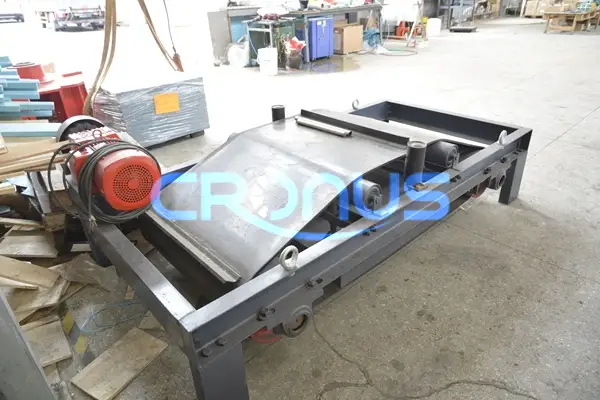
Magnetic separators are the key equipment for efficient iron removal in Raymond mills. For front-end separation, use overhead self-cleaning magnetic separators or magnetic pulleys. For mid-end separation, use pipeline permanent magnetic separators. For back-end purification, use high-gradient electromagnetic separators.
Function IntroductionCommon TypesSelection GuideCommon Mistakes to Avoid
The Role of Magnetic Separators in a Raymond Mill System
In industrial grinding processes, if iron contaminants enter the raw material, they can not only damage the grinding rollers and rings—increasing maintenance costs for the Raymond mill—but also potentially clog the mill, classifier, conveying pipes, and cyclone collectors, thereby impacting classification accuracy and production efficiency. If these iron impurities end up in the final product (e.g., in ceramic glazes, paints, or papermaking fillers), they will directly affect the powder quality (such as color, purity, and uniformity). Furthermore, collisions involving iron fragments inside the equipment can cause sparks and abnormal vibrations, posing safety risks. Therefore, equipping the system with an efficient magnetic separator is key to ensuring safe, stable operation and maintaining product quality.
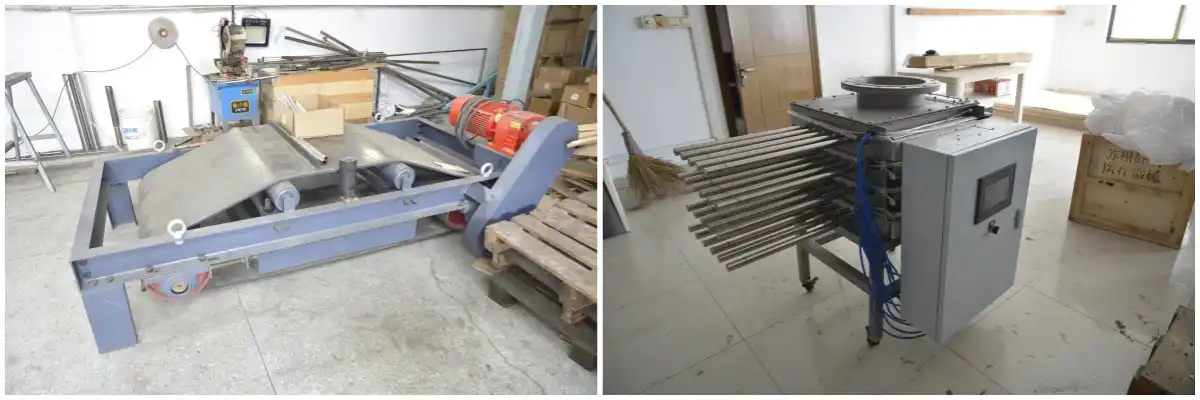
In a typical powder production line, iron removal is rarely achieved by a single device. Instead, a multi-stage separation process is employed to handle different forms of impurities at various stages:
| The Role of Magnetic Separators in a Raymond Mill System | ||
| Front-End Magnetic Separator | Mid-End Magnetic Separator | Back-End Magnetic Separator |
| Raw material pre-treatment to remove large tramp iron. | Protecting the mill by removing residual small iron particles after crushing. | Final product purification to remove fine iron particles generated during grinding. |
| Installed under the raw material bin discharge or on the belt conveyor. | Installed at the bottom of the bucket elevator, in the feed chute, or at the mill's feed inlet. | Installed at the classifier outlet, in the product conveying pipe, or before the packing machine. |
| Typically self-cleaning magnetic separators, suspended over the conveyor belt. | Typically pipeline permanent magnetic separators, installed inside enclosed chutes. | Requires high-gradient (≥15,000 Gauss) electromagnetic separators. |
Common Types of Supporting Magnetic Separators for Raymond Mills
The most common types of magnetic separators used in Raymond mill systems include Overhead Self-cleaning Magnetic Separators, Pipeline Magnetic Separators, and Magnetic Pulleys (Magnetic Head Pulleys).
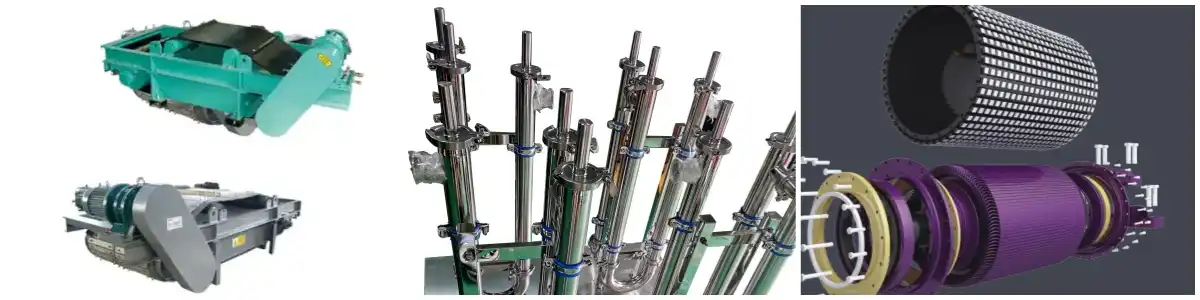
Overhead Self-cleaning Magnetic Separator (Left), Pipeline Magnetic Separator (Center), Magnetic Pulley (Right)
| Comparative Analysis of Common Supporting Magnetic Separators for Raymond Mills | ||
| Overhead Self-cleaning Magnetic Separator | Pipeline Magnetic Separator | Magnetic Pulley |
| Front-end or Mid-end Separation |
Mid-end Separation |
Front-end Separation |
| Suspended above the belt conveyor. | Installed in pipelines or equipment feed inlets. | Replaces the standard head pulley of a conveyor. |
| Generates a strong magnetic field to attract iron; a belt carries it to a non-magnetic area for automatic discharge. | Built-in magnetic rods adsorb iron fines from the powder; requires periodic manual cleaning. | Uses magnetism to attract iron as material is discharged; rotates to a non-magnetic area for automatic shedding. |
| Requires external power (to drive the belt). | No power required (magnetic rods themselves consume no energy; cleaning is manual). | No power required (driven by the conveyor belt's friction). |
| Highly automated, enables continuous automatic iron removal. | Low automation, requires manual periodic cleaning of magnetic rods. | Highly automated, enables continuous automatic separation. |
| Suitable for bulk materials on belt conveyors. | Suitable for powdered materials in pneumatic conveying or vertical drop applications. | Suitable for materials with low iron content and small particle size. |
| Strong magnetic field, high processing capacity, automated operation. | Specifically designed for pipelines, tailored for powdered materials. | Simple structure, can serve as the drive pulley, dual-purpose. |
Selection Recommendations for Supporting Magnetic Separators of Raymond Mill
Conveying Method
If the material has a large particle size and high flow velocity (e.g., belt conveying), it is recommended to choose an overhead self-cleaning magnetic separator or a magnetic pulley. Both have a rugged construction and are impact-resistant. Overhead separators are suitable for continuous iron removal along the conveyor line, while magnetic pulleys are typically installed at the head of the belt conveyor to separate ferrous materials. If the material is powder, conveyed pneumatically, or in vertical drop, a pipeline magnetic separator should be selected. Its magnetic rods can fully cover the flow cross-section, efficiently capturing iron impurities.
Material Moisture and Viscosity
For materials with high humidity or viscosity, it is advisable to choose a more powerful overhead magnetic separator, which can effectively prevent material adhesion and clogging. A magnetic pulley can also be used, but it is necessary to ensure the material can be discharged cleanly to avoid adhesion affecting separation efficiency.
Characteristics of Iron Contaminants
If the iron contaminants are large lumps or scattered large pieces, choose an overhead self-cleaning magnetic separator. It offers high processing capacity and a wide magnetic field for effective removal. If the contaminants are fine iron filings or distributed as fine powder, select a pipeline magnetic separator. Its densely arranged magnetic rods have an excellent adsorption effect on fine iron particles, making it particularly suitable for high-precision iron removal. If the iron content is low and the particle size is small, choose a magnetic pulley, which can complete separation synchronously during material transfer, offering a simple structure and efficient operation.
Process and Budget Considerations
When selecting a magnetic separator, factors such as process requirements and budget must be considered comprehensively. Overhead self-cleaning magnetic separators are suitable for continuous operation scenarios with ample space, supporting automatic iron discharge to minimize labor costs. Pipeline magnetic separators have a compact structure and can be directly embedded in space-constrained areas (e.g., pipe connections). Among these, automatic types are suitable for continuous processes, while non-automatic types have lower costs and meet the basic needs of intermittent production. Magnetic pulleys integrate iron removal and transmission functions, offering high overall cost-performance and are suitable for new or modified conveyor lines.
Common Mistakes to Avoid for Magnetic Separator in Raymond Mill System
Installing Only One Iron Separator Before the Mill
Metal contaminants primarily originate from the raw ore, but can also come from worn parts of the crusher. Installing only one iron separator before the mill fails to protect upstream equipment. Furthermore, iron particles ground into fine powder become more difficult to remove, affecting the whiteness of the final product.
The correct practice is to install iron separators after the crusher and before the mill, creating a multi-stage iron removal protection system.
Improper Installation Position of the Iron Separator
Iron separators have strict requirements regarding material layer thickness (typically ≤ 100mm). An excessively thick layer prevents the magnetic field from attracting iron contaminants at the bottom, resulting in low efficiency.
The correct practice is to install the iron separator on a horizontal section where the material passes through in a thin, uniform layer, such as at the head of a belt conveyor or the outlet of a vibrating screen.
Ignoring the Impact of Material Characteristics on Separation Efficiency
Processing high-moisture material directly through an iron separator can encapsulate iron contaminants, hindering their attraction. It may also cause the material to adhere to the magnetic poles, reducing magnetic field strength and leading to decreased efficiency.
The correct practice is to dry high-moisture material before iron separation, or to install a vibrating screen to separate wet and dry materials.
Neglecting Cleaning and Maintenance of Magnetic Separator
Permanent magnets will gradually demagnetize after years of use, while electromagnetic coils will lose magnetic force due to aging. Failure to inspect and replace them will result in loss of separation capacity. Meanwhile, if iron impurities are not cleaned regularly, accumulation will lead to "magnetic short circuit," and dust buildup on coils will cause poor heat dissipation, reducing the magnetic force of the separator. In severe cases, it may damage the equipment or contaminate the finished product.
The correct practice is to perform regular cleaning, follow standard operating procedures, prevent demagnetization, and conduct safety inspections to ensure proper cleaning and maintenance of the magnetic separator.
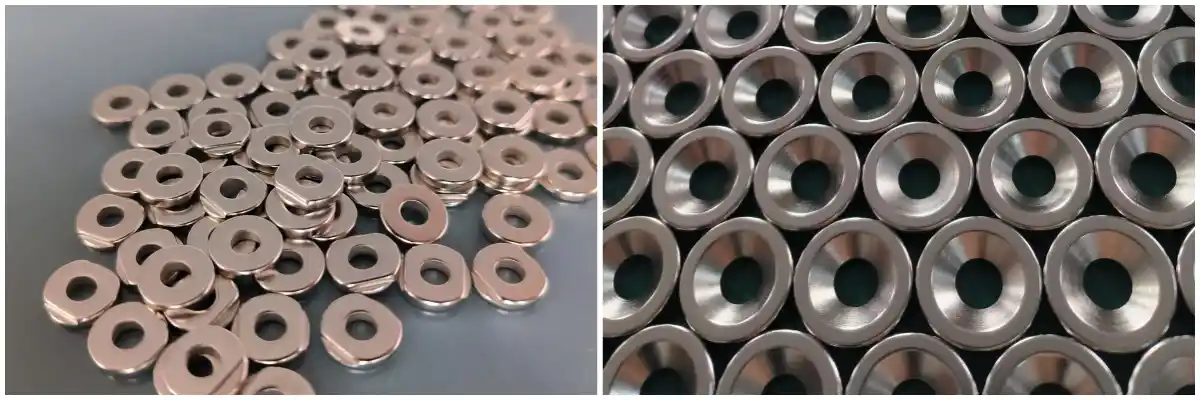
NdFeB Permanent Magnet
- Previous Article:How to Select a Supporting Crusher for a Raymond Mill?
- Next Article:没有了!
- Can Sand‑Powder Integrated Machines Truly Achieve Co‑production? Equipment Selection Guide
- Deep‑Dive Analysis of Working Principle of Raymond Mill
- European Version, German Version, Vertical Swing Type Grinding Mills: Genuine Upgrade or Fake Concep
- Comparative Analysis of Inverted Cone Rotor and Cylindrical Rotor for Raymond Mill
 Home
Home Products
 About
About Call
Call