

Deep‑Dive Analysis of Working Principle of Raymond Mill
- Time:2026-05-14
- Views:18
The working principle of a Raymond mill is not simply about crushing and grinding. This article, drawing on over 50 years of industry experience from Cronus Machinery, systematically explains the working mechanism of the Raymond mill from the aspects of system composition, process flow, and grinding principle.
System ProcessPulverization PrincipleAttrition Mechanism
System Composition and Technological Process of Raymond Mill
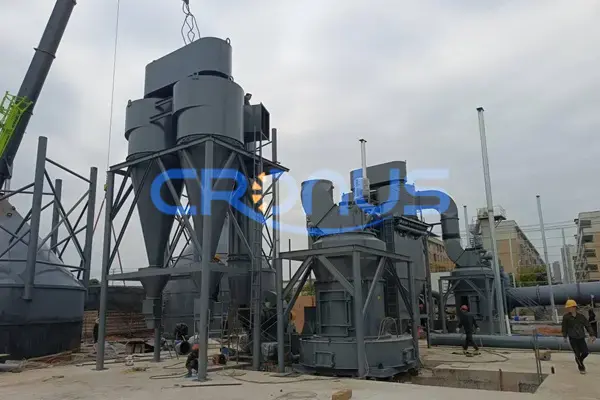
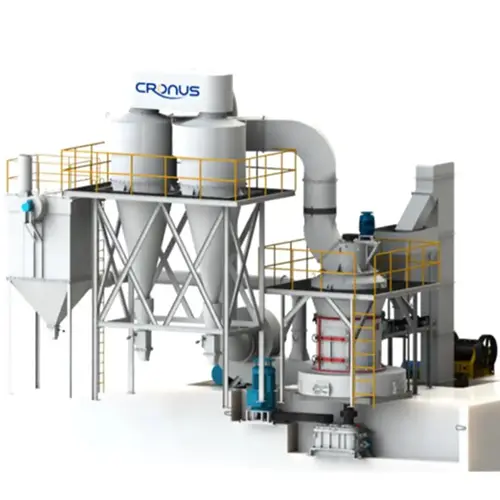
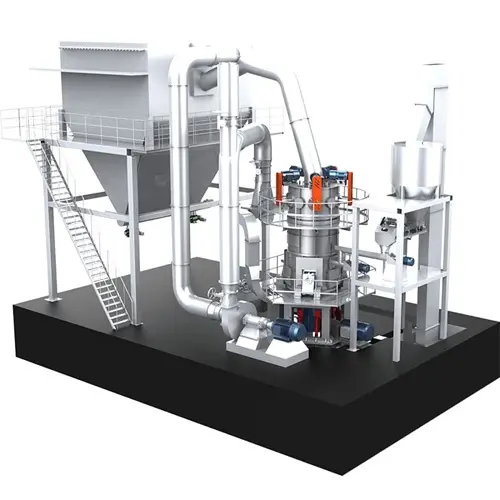
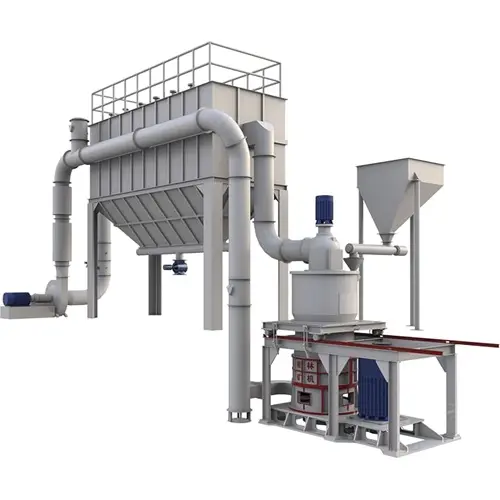
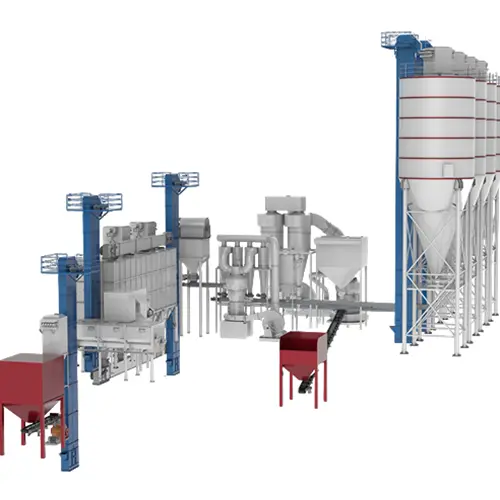
The complete Raymond mill system consists of six core units: crushing, feeding, grinding, classification, collection and dust removal. The complete technological process is as follows:
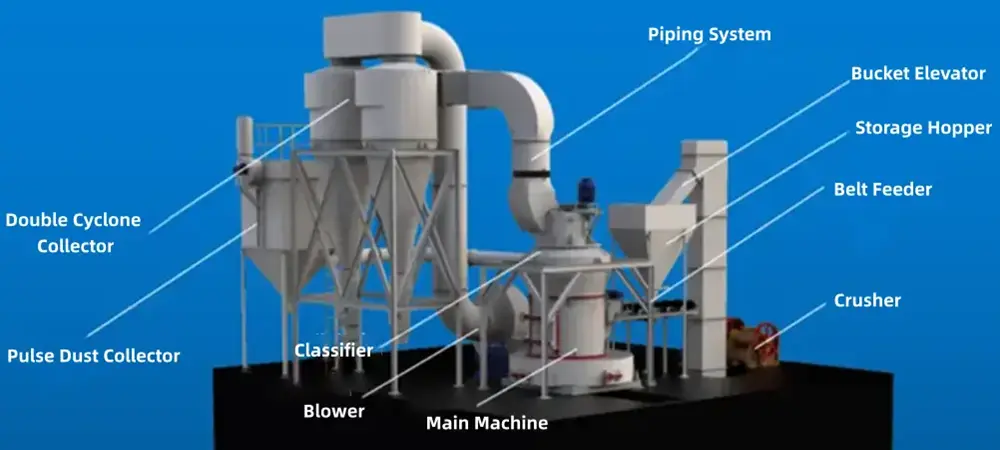
Raw Material Pretreatment: Lump raw ore is first crushed by jaw crusher into particle size meeting feed requirements, then conveyed into storage bin by bucket elevator for temporary storage, and finally quantitatively, evenly and continuously fed into the main machine grinding chamber via vibrating feeder.
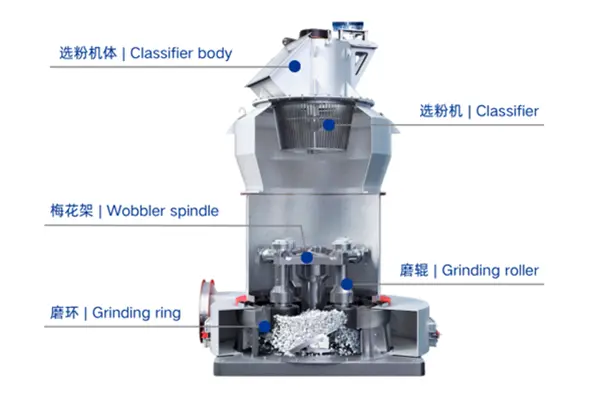
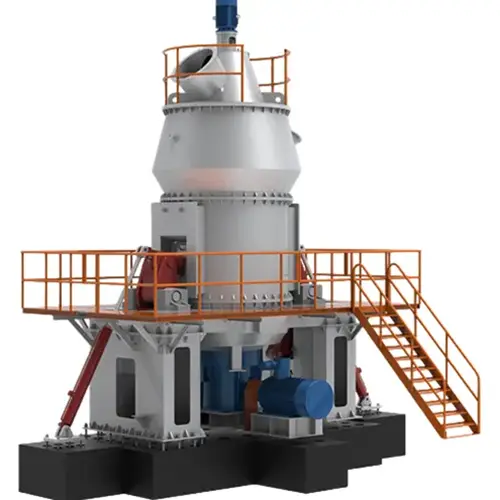
Material Grinding: The main motor drives the main shaft and plum frame to rotate synchronously through reducer. The roller assemblies suspended on the plum frame rotate on their own while revolving with the main shaft. Under centrifugal force, the grinding rollers press outward against the grinding ring fixed on the inner wall of the grinding chamber. Afterwards, rotating shovels scoop materials falling to the bottom of the grinding chamber and throw them between grinding rollers and grinding rings for grinding and pulverization.
Air Classification: High‑pressure airflow generated by blower flows upward from the bottom of the grinding chamber, lifting ground powder into the classifier above the main machine. The high‑speed rotating classifier impeller forms a centrifugal force field to precisely classify powder in airflow: qualified fine powder passes through impeller gaps and enters the collection system with airflow. Oversized coarse powder is blocked by impeller blades, falls back to the bottom of the grinding chamber for re‑grinding, forming a closed‑circuit circulation.
Collection and Dust Removal: Powder‑laden airflow firstly enters cyclone collector, where over 90% of finished powder is separated and collected by centrifugal sedimentation principle and discharged as finished products through discharge valve. The residual small amount of dust‑laden airflow enters pulse baghouse dust collector. After being filtered by filter bags, clean air is discharged into the atmosphere. The whole system operates under closed negative‑pressure environment with no dust leakage.
Pulverization Principle of Raymond Mill
The core pulverization principle of Raymond mill is suspended bed attrition mechanism, which is essentially different from pulverization mechanisms of vertical mill and ball mill. It realizes mild and continuous material pulverization through synergistic action of centrifugal force, friction force and gravity.
Formation of Suspended Material Bed
Suspended material bed is an important structural feature distinguishing Raymond mill from other grinding mills and the key to realizing attrition principle. Its formation process is as follows:
During operation, shovels rotate at an inclination angle of 30°~45° with the main shaft, scoop materials at the bottom of the grinding chamber and throw them in tangential direction, forming a loose material bed with thickness of 5~15 mm between grinding rollers and grinding rings. The material bed is uncompacted with bulk density of about 0.4~0.6 t/m³ and sufficient gaps among particles, facilitating full contact between materials and grinding rollers/rings, which is one of the main reasons for high pulverization efficiency of Raymond mill.
Synergistic Working Mechanism of Three Forces
Centrifugal Force: Centrifugal force is the primary source of grinding pressure for Raymond mill, which is fundamentally different from hydraulic pressurization adopted by vertical mills. Its magnitude is determined by main shaft rotational speed, generally fixed at 120~180 r/min in industrial production and not recommended for random adjustment. Fine‑tuning of grinding pressure can be realized by adjusting roller counterweights. Blindly increasing rotational speed will accelerate wear of vulnerable parts and may cause motor overload. Reducing rotational speed will not lead to overload but decrease grinding pressure and output.
Friction Force: Material pulverization mainly relies on sliding friction generated by relative motion between grinding rollers and grinding rings to strip particle surface layer by layer. Friction efficiency is mainly affected by surface roughness of grinding rollers and rings, material moisture content and material hardness.
Gravity: The balance between shovel throwing force and material gravity determines thickness and stability of material bed. Excessive throwing force increases proportion of coarse powder in finished products. Insufficient throwing force may cause dry grinding with direct contact between grinding rollers and rings, accelerating loss of vulnerable parts.
Micro‑Mechanism of Attrition Process in Raymond Mill
The attrition process of Raymond mill is divided into three stages: contact stage, micro‑crack propagation stage and surface layer stripping stage.
Material particles first contact rotating grinding rollers. Shear stress generated by friction force forms micro‑cracks on particle surfaces. When stress accumulates to critical value, surface layers peel off in flakes layer by layer to produce qualified fine powder.
This mild and continuous process effectively avoids over‑pulverization, delivering finished powder with rounded particle shape, uniform particle size distribution and precisely controllable fineness. This is the core reason why Raymond mill has long maintained a dominant position in soft material (Mohs hardness ≤7) powder processing with fineness of 80~400 mesh.
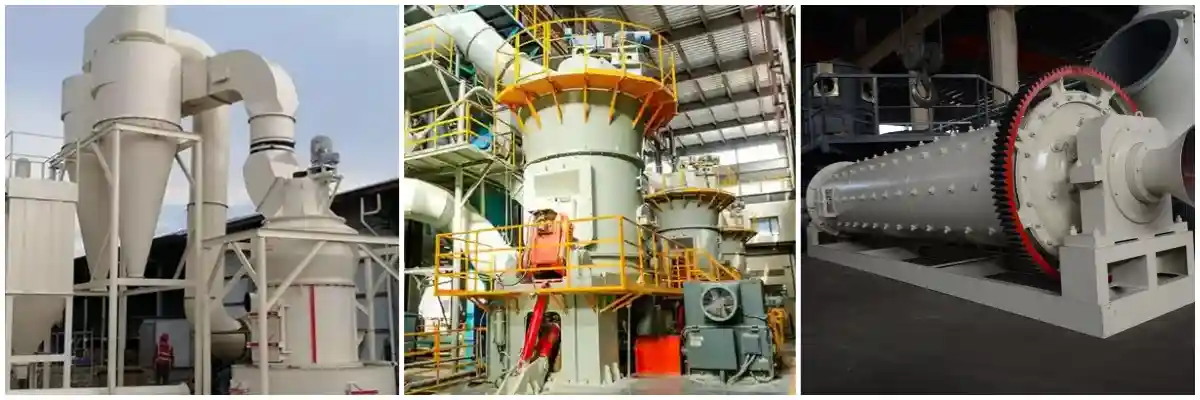
| Comparative Analysis of 80~400 Mesh Grinding Mills | |||
| Comparison Items | Raymond Mill | Vertical Mill | Ball Mill |
| Pulverization Principle | Suspended bed attrition | High‑pressure compacted bed compression‑shearing | Impact‑grinding combination |
| Material Bed State | Loose, dynamic, suspended | Dense, compacted, continuous | Dispersed, tumbling, impacting |
| Powder Particle Shape | Rounded, good fluidity | Relatively regular particles, slightly more edges and corners | Sharp‑edged, more flaky particles |
| Particle Size Distribution | Uniform distribution | More uniform distribution with narrow range | Wide distribution with over‑pulverization |
| Unit Energy Consumption | Medium‑low | Low | High |
| Investment Cost | Low | High | High |
In summary, in‑depth understanding of suspended bed attrition principle of Raymond mill helps to solve practical problems such as low output, unstable fineness, excessive wear and high energy consumption in a targeted manner, so as to give full play to the technical and economic advantages of the equipment.
 Home
Home Products
 About
About Call
Call