

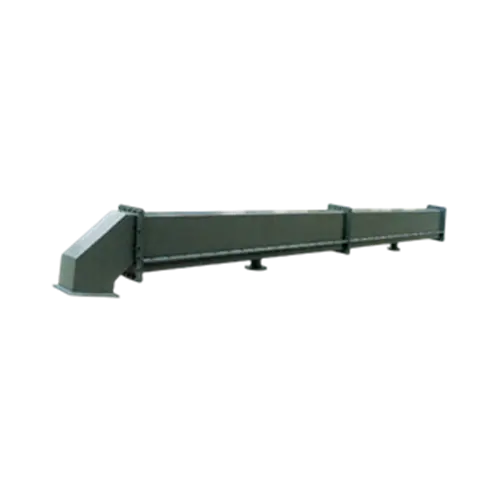
Airslide Conveyo
Features and Advantages of Airslide Conveyor
Exceptionally Low Energy Consumption: Compared to traditional mechanical conveying methods such as screw or belt conveyors, the power requirement is significantly lower, resulting in substantial energy savings during operation.
Simple Structure: Lacks complex transmission components like bearings, chains, or helical flights. The main consumable part is the permeable fabric layer. Replacement is straightforward, leading to minimal maintenance workload, low operating costs, and quiet operation (primary noise source is the accompanying fan).
Efficient Conveying: Suitable for transporting powdered materials. The fluidization conveying principle ensures high efficiency, meeting the continuous high-capacity feeding demands of large Raymond mills.
Enclosed and Contamination-Free: Materials are conveyed in a fluidized state within a sealed trough, preventing dust emission and protecting materials from moisture or external contamination.
High Adaptability: Can be flexibly arranged in horizontal, inclined, or other configurations according to plant layout and process requirements, with lenient space installation demands.
Working Principle of Airslide Conveyor
Compressed Air Supply: A centrifugal fan supplies stable low-pressure air into the enclosed lower chamber. The air permeates through the porous permeable layer into the upper material bed, fluidizing the powder.
Inclined Sliding: The fluidized material slides smoothly under its own gravity from the higher inlet to the lower outlet along the slightly inclined trough.
Gas-Solid Separation: Excess gas generated during conveyance is purified and discharged through a dust filtration device in the upper part of the trough, achieving gas-solid separation.
- How to construct a standard foundation for a Raymond Mill?
- Can Sand‑Powder Integrated Machines Truly Achieve Co‑production? Equipment Selection Guide
- Deep‑Dive Analysis of Working Principle of Raymond Mill
- Why do the grinding roller shaft and the central shaft of a Raymond mill need to undergo heat treatm
- European Version, German Version, Vertical Swing Type Grinding Mills: Genuine Upgrade or Fake Concep
- Can a Raymond mill grind multiple materials together?
 Home
Home Products
 About
About Call
Call