

Comparative Analysis: Raymond Mill vs. Ultrafine Ring Roller Mill
- Time:2026-03-19
- Views:52
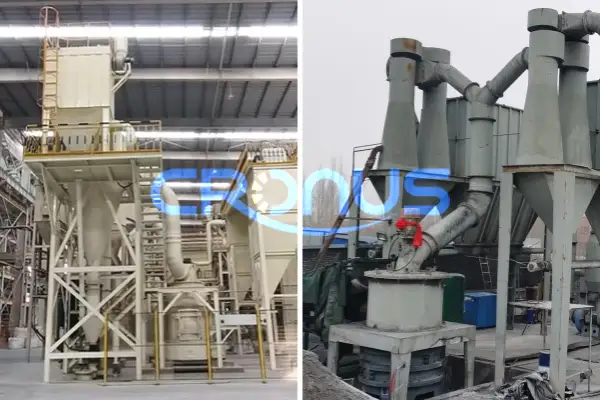
Both Raymond Mill and Ultrafine Ring Roller Mill are highly cost-effective grinding equipment, yet they serve different application fields. The Raymond Mill is suitable for processing medium-fine powders ranging from 80~400 mesh, while the Ultrafine Ring Roller Mill is designed for ultrafine powder processing between 400~2500 mesh.
Working Principle AnalysisPerformance ComparisonApplication RecommendationsFrequently Asked Questions
Core standards referenced in this article: JB/T 13877-2020 Pendulum Mill, JB/T 14059-2020 Ultrafine Ring Roller Mill, GB/T 50542-2019 Code for Design of Powder Engineering.
Working Principle Analysis: Raymond Mill vs. Ultrafine Ring Roller Mill
Working Principle of Raymond Mill
The Raymond Mill employs multiple grinding rollers (≥2) that operate against a single grinding ring. During operation, material is lifted by a rotating shovel and thrown into the material bed formed between the rollers and the ring. The rollers, driven by centrifugal force, press firmly against the ring to crush the material. An integrated classifier, consisting of a rotor and blades, controls the product fineness by adjusting its rotational speed. Coarse particles are returned for regrinding, while fines meeting specifications pass through to the collection system. The resulting powder has uniform particle size, adjustable within the range of 80 to 400 mesh.
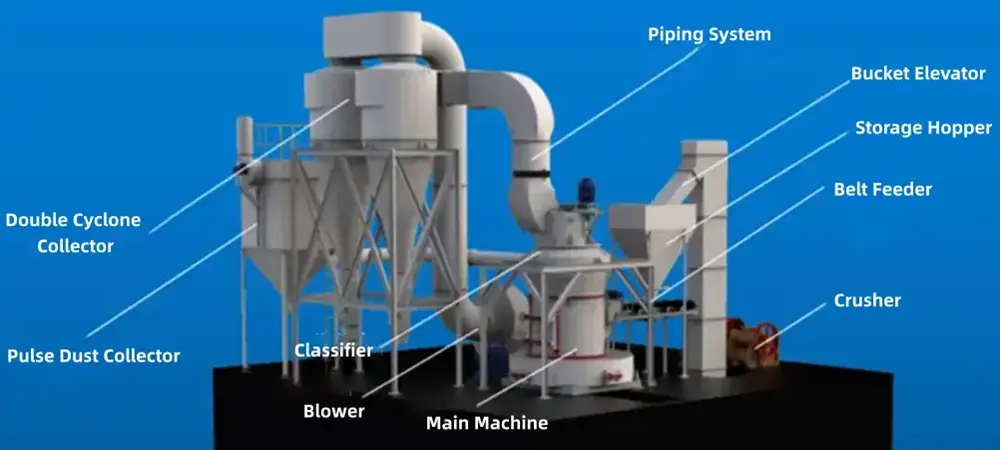
The 80~400 mesh range represents the high-efficiency grinding zone for Raymond Mills. While it is possible to grind materials finer than 400 mesh, achieving this requires significantly increasing the classifier wheel speed and reducing the system airflow. This makes it difficult for qualified fine powder to be discharged promptly, severely limiting production capacity. Although modifications like adding a high-pressure grinding device (e.g., High-Pressure Suspension Mill) or an ultra-fine classifier can push the upper limit to achieve 600 mesh, its most efficient operational range remains 80~400 mesh.
Working Principle of Ultrafine Ring Roller Mill
The Ultrafine Ring Roller Mill utilizes a collaborative system of multiple grinding rings and rollers. Typically, each ring assembly is paired with numerous (≥15) rollers. During operation, rollers on a rotating disk are driven to roll tightly against the inner wall of the grinding ring. Material forms multi-layer beds (2~4 layers) within the grinding chamber and undergoes repeated compression by the multiple roller-ring sets, achieving ultrafine size reduction. The classification system employs a centrifugal turbo classifier. A high-speed rotating classifier wheel generates strong centrifugal force; its speed is infinitely adjustable. A higher-precision secondary classification system is optional. The final product features a concentrated particle size distribution, precisely controllable within the 400~2500 mesh range.
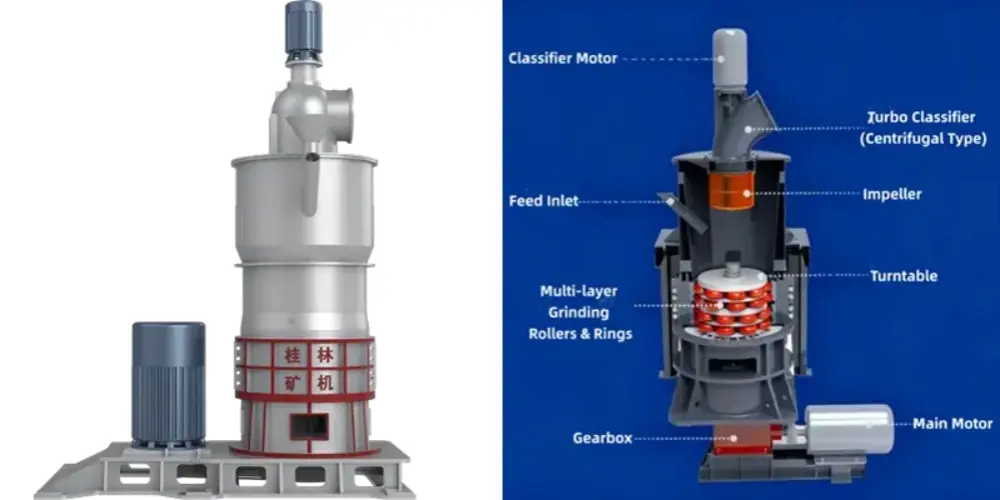
Although the Ultrafine Ring Roller Mill can process medium-fine powders in the 80~400 mesh range, its performance is excessive for this task, making it cost-ineffective. Its precision classification system requires significantly reducing the classifier speed and system airflow to allow coarser particles to pass. In this mode, it cannot match the efficiency of a Raymond Mill for this fineness range, and its initial investment cost remains substantially higher.
Performance Comparison: Raymond Mill vs. Ultrafine Ring Roller Mill
The following data is based on testing with calcite material (Mohs hardness 3, feed size ≤20mm, product moisture ≤1%). Raymond Mill tests were conducted in the 80~400 mesh range (with 400 mesh as the upper limit), and Ultrafine Ring Roller Mill tests in the 400~1250 mesh range (requiring a secondary classification system for fineness above 1250 mesh). Data is for reference only, as actual parameters vary with raw material and process conditions. For specific parameters tailored to your needs, please consult us; our professional technical team is ready to assist.
Energy Utilization
Raymond Mill: Energy utilization rate 6%~9%, over-grinding rate ≤25%. Specific power consumption exceeds 38 kWh/t when producing 400 mesh powder. Energy consumption increases exponentially with product fineness when targeting >325 mesh.
Ultrafine Ring Roller Mill: Simultaneous compression by multiple roller-ring sets yields an energy utilization rate of 12%~18%, over-grinding rate ≤18%. Specific power consumption is controlled within 45~55 kWh/t, with no exponential energy increase observed in the 400-1250 mesh range.
Scale and Application
Raymond Mill: Suitable for non-flammable and explosive brittle materials with Mohs hardness ≤7. Offers wide material adaptability and high tolerance for impurities and hardness variations. Requires feed size ≤30mm (≤35mm for larger models) and feed moisture ≤6%. Pre-drying equipment is needed for high-moisture materials. Single-unit capacity ranges from 0.3 to 35 t/h, with a maximum annual output of ≤300,000 tons. Primarily used for small to medium-scale processing of conventional powders in the 80~400 mesh range.
Ultrafine Ring Roller Mill: Designed for brittle, non-metallic minerals of low to medium hardness (Mohs hardness ≤7). Has strict requirements for feed size (≤20mm), moisture (≤4%), and impurity control. Processing high-moisture, sticky materials can lead to clogging and requires pre-drying equipment and a pulse-jet membrane filter baghouse. Single-unit capacity ranges from 0.6 to 10 t/h, with an annual output of 10,000 to 100,000 tons. It is the primary equipment for small to medium-scale ultrafine powder processing (above 400 mesh).
Product Fineness
Raymond Mill: Utilizes a dynamic classification system (rotating impeller). Product fineness ranges from 80 to 400 mesh with uniform particle size distribution, achieving a 325 mesh sieve residue of ≥95%. Can reach up to 600 mesh when equipped with an ultrafine classifier or high-pressure grinding device, but throughput and efficiency above 400 mesh remain limited. The high-efficiency grinding zone is still 80~400 mesh.
Ultrafine Ring Roller Mill: Features a high-precision centrifugal turbo classifier (single or multi-wheel options). Product fineness ranges from 400 to 2500 mesh with a concentrated particle size distribution and high classification precision. The product particle size (D97) is precisely controllable. A higher-precision secondary classification system is required for processing powders above 1250 mesh.
Operation and Maintenance Costs
Raymond Mill: Lower initial investment cost, approximately 50%~60% that of an Ultrafine Ring Roller Mill. Core wear parts are grinding rollers and rings. Using conventional high-manganese steel, service life ranges from 800 to 2500 hours when grinding calcite. Replacement downtime is 4~6 hours per change. Simple structure facilitates easy operation and maintenance.
Ultrafine Ring Roller Mill: Higher cost compared to Raymond Mill but economically favorable compared to other ultrafine mills (e.g., Ultrafine Vertical Roller Mill). Core wear parts are grinding rollers and rings, manufactured from high-chrome wear-resistant alloy. Service life reaches 6000 to 10000 hours when grinding calcite. Replacement downtime is 8-12 hours per change. Its precision structure requires higher technical expertise from maintenance personnel.
How to Choose Between Raymond Mill and Ultrafine Ring Roller Mill?
Both Raymond Mill and Ultrafine Ring Roller Mill offer high cost-performance for efficient grinding, but their applications differ. The target fineness range is the primary factor to consider during selection.
Applications Suitable for Raymond Mill
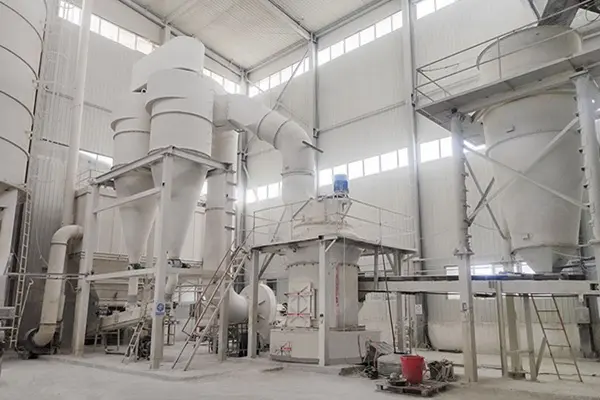
The Raymond Mill is ideal for small to medium-scale production of medium-fine powders (80~400 mesh), primarily for non-flammable, explosive brittle materials with Mohs hardness ≤7. For processing ultrafine powders above 400 mesh, selecting a dedicated ultrafine mill is generally recommended. Retrofitting an existing Raymond mill with an ultrafine classifier is an option only when the mill is already owned and the goal is to venture into ultrafine powder production.
Applications Suitable for Ultrafine Ring Roller Mill
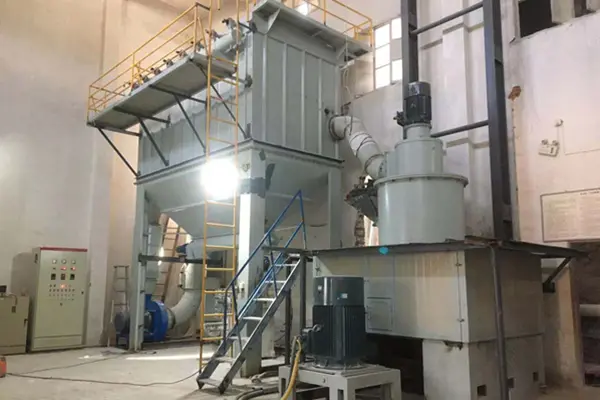
The Ultrafine Ring Roller Mill is designed for small to medium-scale production of ultrafine powders (400~2500 mesh), mainly for brittle, non-metallic minerals with low to medium hardness (Mohs hardness ≤7). For high-capacity, large-scale ultrafine powder production, an Ultrafine Vertical Roller Mill is often recommended. For ultrafine grinding of hard materials (e.g., quartz), a ball mill classification production line (ball mill + air classifier) is suggested.
| Comparison of Attributes: Raymond Mill vs. Ultrafine Ring Roller Mill | ||
| Attribute | Raymond Mill | Ultrafine Ring Roller Mill |
| Finished Product | Uniform particle size, 325 mesh sieve residue ≥95% | Concentrated particle size, precisely controllable D97 |
| 80~400 mesh (Medium-Fine) | High-efficiency grinding zone | Performance excessive, inefficient |
| 400~2500 mesh (Ultrafine) | Fineness limited (600 mesh with special process) | High-efficiency grinding (above 1250 mesh requires secondary classification) |
| Processing High Hardness Materials (Mohs >7) | Rapid wear; requires upgraded components (e.g., ceramic liners) or switch to High-Pressure Suspension Mill | Not recommended (primarily for materials ≤7 Mohs); consider ball mill classification line |
| Processing High Moisture Materials (>6%) | Requires feed moisture ≤6%; needs pre-drying equipment | Requires feed moisture ≤4%; needs pre-drying equipment and pulse-jet membrane filter baghouse |
| Small to Medium Scale Production | Lower investment cost, 50%~60% of Ultrafine Ring Roller Mill | Higher than Raymond Mill, lower than other ultrafine mills |
| Large Scale Production (Annual Output ≥300,000 tons) | Can use larger models or multiple units in parallel | Capacity limited; Ultrafine Vertical Roller Mill recommended |
| Operation & Maintenance | Simple structure, easy maintenance | Precision structure, requires skilled maintenance technicians |
Frequently Asked Questions: Raymond Mill vs. Ultrafine Ring Roller Mill
For 80~400 mesh medium-fine powder, should I choose a Raymond Mill or an Ultrafine Ring Roller Mill?
For processing 80~400 mesh powder, choose the Raymond Mill. As the name suggests, the Ultrafine Ring Roller Mill is an ultrafine mill designed for processing ultrafine powders (400~2500 mesh). While someone might suggest using an Ultrafine Ring Roller Mill for 80~400 mesh powder, and it technically can grind it, its cost and efficiency are far from optimal compared to a Raymond Mill.
Can a Raymond Mill equipped with an ultrafine classifier achieve the same effect as an Ultrafine Ring Roller Mill?
No. Even with an ultrafine classifier capable of producing 600 mesh powder, the high-efficiency grinding zone of a Raymond Mill remains 80~400 mesh. Although its initial cost might be lower than an Ultrafine Ring Roller Mill, for long-term operation in the ultrafine range, the Ultrafine Ring Roller Mill is the preferred choice.
Can an Ultrafine Ring Roller Mill replace a Raymond Mill?
No. The two are complementary, not interchangeable. Their areas of focus are entirely different: the Raymond Mill is suited for 80~400 mesh medium-fine powder, while the Ultrafine Ring Roller Mill is suited for 400~2500 mesh ultrafine powder. Clearly defining the target fineness range is crucial during equipment selection.
- Previous Article:Comparative Analysis of Raymond Mill and Ball Mill
- Next Article:Comparative Analysis of Raymond Mill and Vertical Mill
 Home
Home Products
 About
About Call
Call