

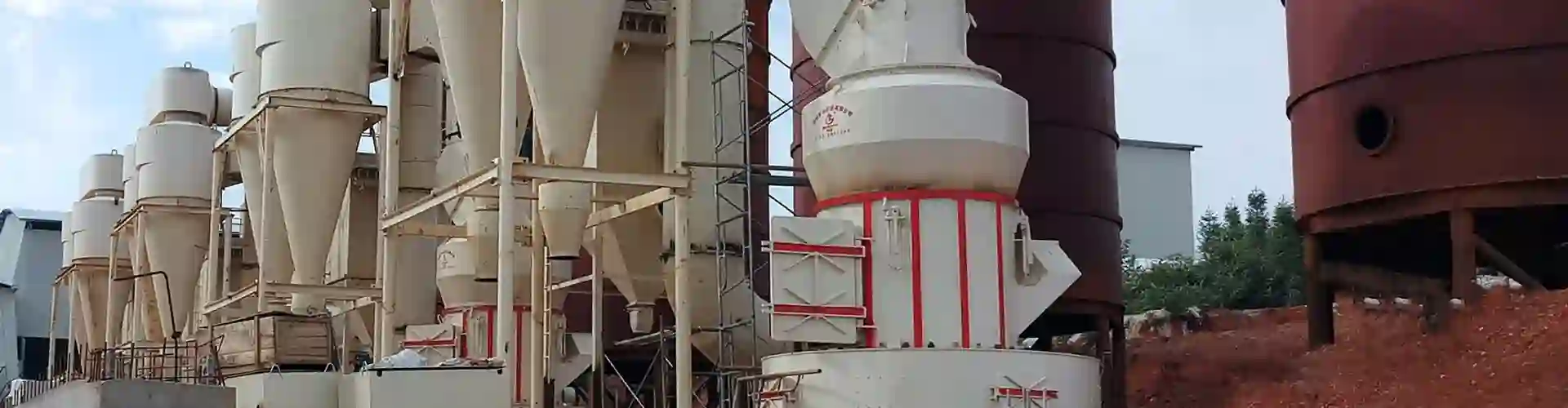
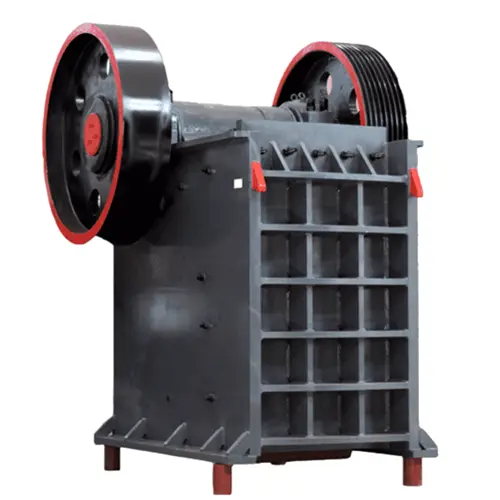
Jaw Crusher
Production Output:2~1400t/h
Feed Size:≤1250mm
Product Size:≤650mm
Suitable Materials:Granite, marble, river pebble, basalt, limestone, iron ore, copper ore, shale, sandstone, bluestone, gypsum, etc.
Jaw Crusher Product Introduction
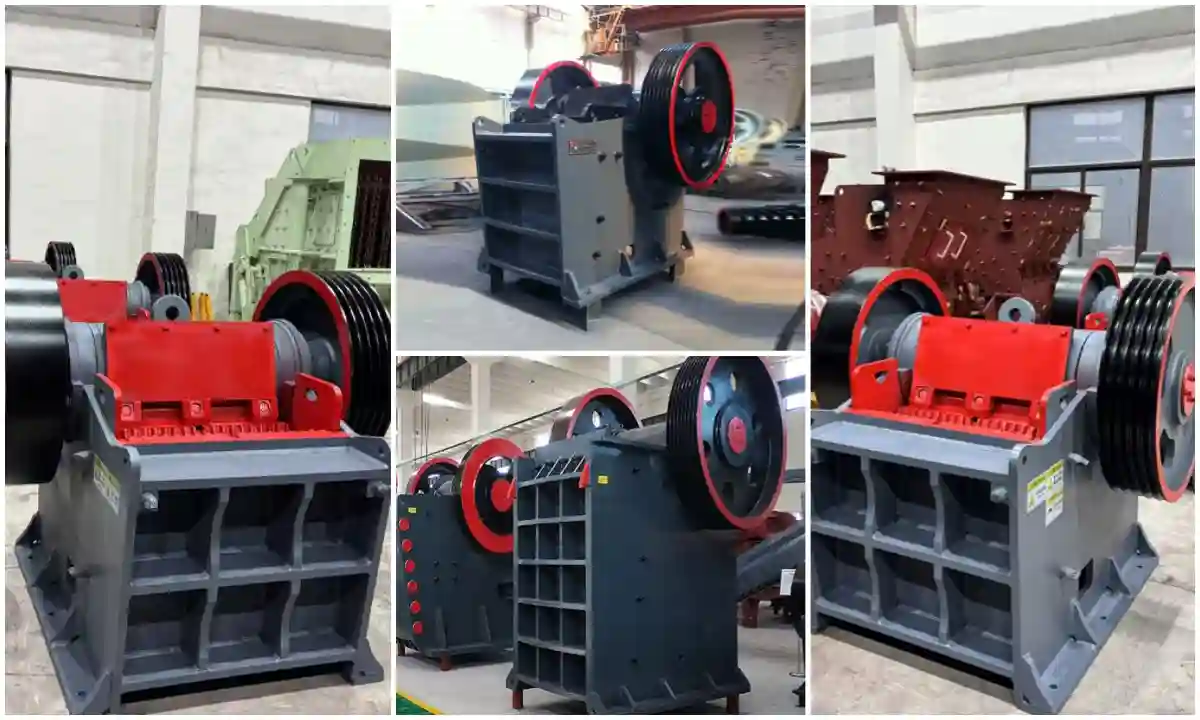
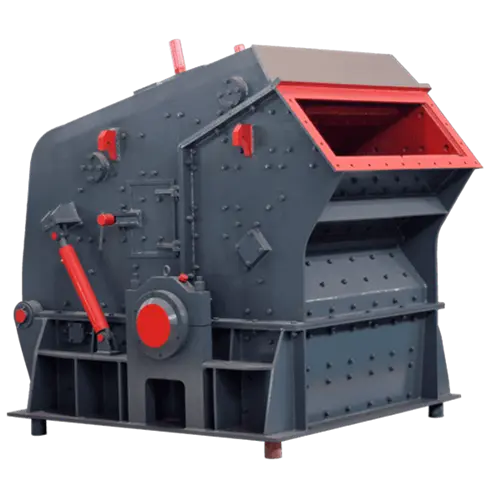
The jaw crusher is a equipment that simulates the jaw movement of animals to crush materials. It can process various minerals with Mohs hardness ≤9 and is widely used in mining, aggregate, metallurgy, building materials, and other industries. Depending on the crushing process and required discharge fineness, it can be classified into primary jaw crushers and fine jaw crushers. In the Raymond mill process, the primary jaw crusher (PE series) is generally used for pre-crushing, producing a coarser discharge. The fine jaw crusher (PEX series) is used in multi-stage crushing applications to further reduce the material from the primary crusher to a finer particle size. Both types provide the ideal feed size for the grinding process, effectively improving the overall efficiency of the grinding production line.
Jaw Crusher Features and Advantages
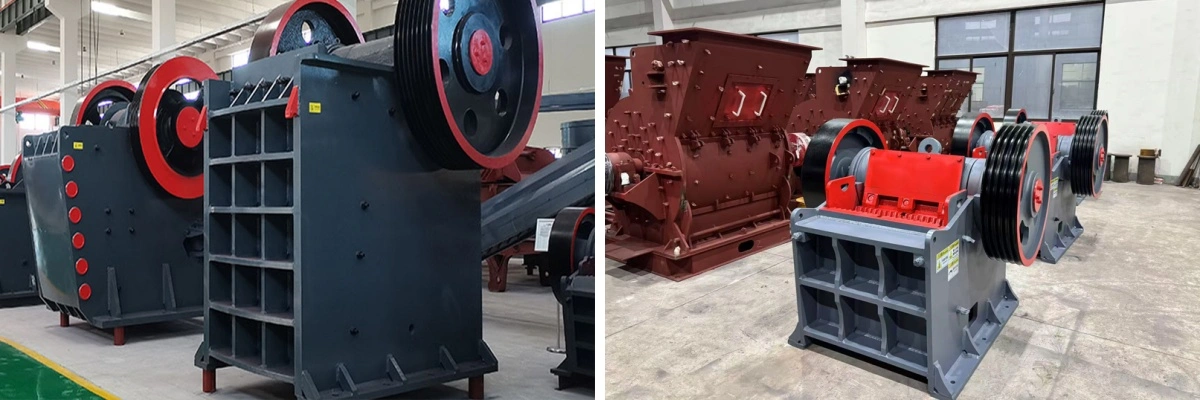
Primary Jaw Crusher
Wide Applicability: Large feed opening design, capable of handling materials up to 1250mm, suitable for various minerals with Mohs hardness ≤9.
High Crushing Efficiency: Large crushing ratio ensures uniform discharge particle size while reducing large blocks to medium and small particles.
Stable and Reliable: Made of high manganese steel wear-resistant material, offering strong impact resistance and wear resistance, capable of withstanding huge crushing impact forces, ensuring stable and reliable crushing process.
Simple and Convenient: Simple structural design, convenient installation, disassembly, and routine maintenance, significantly reducing downtime and maintenance costs.
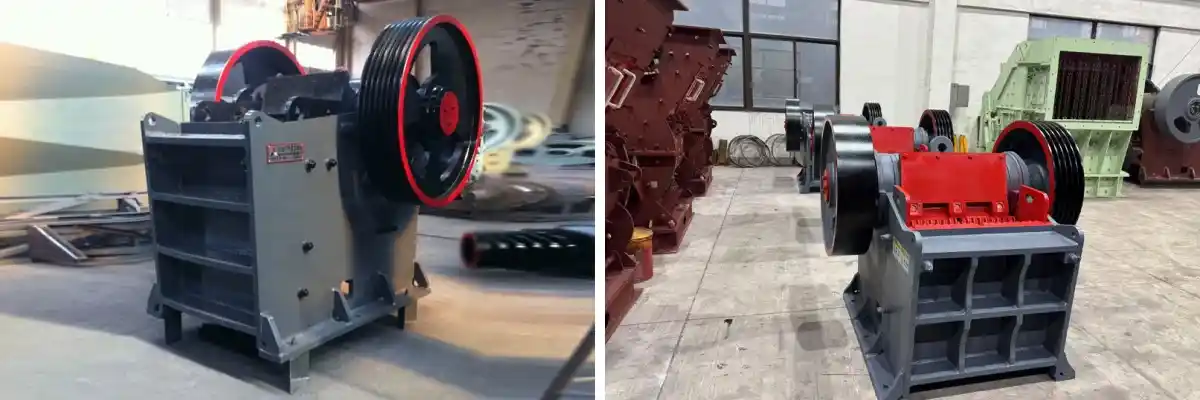
Fine Jaw Crusher
High Crushing Ratio: Specially designed crushing chamber and moving jaw motion trajectory provide a high crushing ratio (≥10), producing finer and more uniform discharge.
High Efficiency, Low Consumption: Optimized suspension point of moving jaw and toggle plate angle improve crushing efficiency and reduce specific energy consumption.
Strong Wear Resistance: Both fixed and moving jaw plates are made of high-strength wear-resistant material for excellent wear resistance.
Uniform Crushing: Specially optimized tooth profile on jaw plates ensures uniform crushing force distribution, extending the service life of wear parts.
| Comparative Analysis: Primary Jaw Crusher vs. Fine Jaw Crusher | |
| Primary Jaw Crusher | Fine Jaw Crusher |
| Large feed size, up to 1250mm | Smaller feed size, requires primary crushing |
| Crushing ratio: 3~6, uniform discharge | Crushing ratio ≥10, finer and more uniform discharge |
| Processes various minerals with Mohs hardness ≤9 | Suitable for low to medium hardness minerals |
| High manganese steel wear-resistant material, strong impact and wear resistance | Fixed and moving jaw plates made of high-strength wear-resistant material, excellent wear resistance |
| Simple structure, convenient installation, disassembly, and maintenance | Optimized moving jaw suspension point, toggle plate angle, and tooth profile for higher efficiency and lower energy consumption |
Jaw Crusher Working Principle
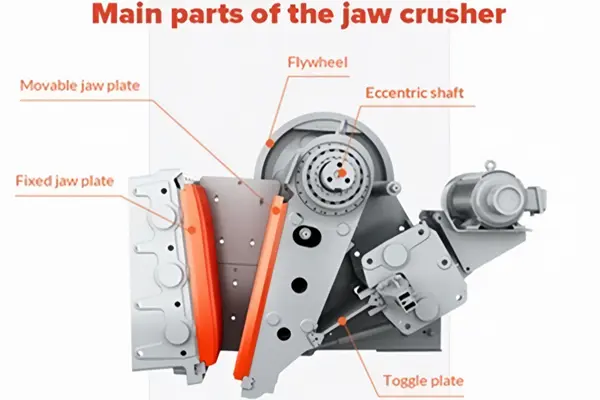
Material enters the crushing chamber through the feed opening and fills the space between the moving jaw plate and the fixed jaw plate. The motor drives the eccentric shaft, causing the moving jaw to reciprocate periodically. When the moving jaw approaches the fixed jaw, the material is crushed by compression and shearing (compressive strength ≤320MPa). When the moving jaw moves away, the crushed material is discharged from the discharge opening by gravity. The crusher is equipped with a hydraulic adjustment system for flexible control of the discharge opening size, allowing precise adjustment of the product particle size. A vibrating screen can be added for classification if required.
Jaw Crusher Application Scenarios
Jaw Crusher Technical Specifications
| Jaw Crusher Specification Table (Primary Crushing) | |||||||
| Model | Feed Opening (mm) | Discharge Opening (mm) | Capacity (t/h) | Motor Power (kW) | Weight (t) | Overall Dimensions (L×W×H) (mm) | |
| PE150×250 | ≤125 | 10~40 | 2~6 | 5.5 | 1 | 900×750×950 | |
| PE250×400 | ≤210 | 20~60 | 8~16 | 15 | 3 | 1450×1280×1300 | |
| PE400×600 | ≤350 | 40~100 | 20~40 | 30 | 6 | 1700×1700×1650 | |
| PE500×750 | ≤400 | 50~120 | 30~80 | 45 | 11 | 2000×1950×1900 | |
| PE600(A)×900 | ≤425 | 60~130 | 45~95 | 55 | 12.5 | 2200×1960×1950 | |
| PE600×900 | ≤480 | 75~200 | 80~200 | 75 | 18 | 2400×2230×2400 | |
| PE700×1000 | ≤550 | 80~210 | 90~240 | 75 | 19.5 | 2400×2280×2400 | |
| PE750×1060 | ≤630 | 80~235 | 120~300 | 90 | 26 | 2500×2370×2780 | |
| PE900×1200 | ≤750 | 96~265 | 280~500 | 110 | 45 | 3200×2820×3260 | |
| PE1100×1400 | ≤900 | 120~260 | 350~750 | 200 | 75 | 3850×3050×4000 | |
| PE1200×1500 | ≤1020 | 150~300 | 700~950 | 250 | 85 | 4050×3150×4200 | |
| PE1300×1600 | ≤1200 | 220~550 | 800~1200 | 355 | 122 | 5100×4700×4300 | |
| PE1500×1800 | ≤1250 | 280~650 | 1000~1400 | 500 | 169 | 5600×5020×4950 | |
| * The above data are for reference only. Specific parameters vary depending on the material. | |||||||
| Jaw Crusher Specification Table (Fine Crushing) | |||||||
| Model | Feed Opening (mm) | Discharge Opening (mm) | Capacity (t/h) | Motor Power (kW) | Weight (t) | Overall Dimensions (L×W×H) (mm) | |
| PEX150×750 | ≤120 | 10~40 | 8~25 | 15 | 3.1 | 1320×1570×1050 | |
| PEX150×1000 | ≤130 | 15~45 | 12~35 | 22 | 5 | 1400×1810×1250 | |
| PEX200×1000 | ≤150 | 15~50 | 12~40 | 22 | 5 | 1530×1810×1250 | |
| PEX200×1200 | ≤180 | 20~60 | 30~100 | 37 | 8.5 | 1650×2150×1460 | |
| PEX250×750 | ≤210 | 20~60 | 15~40 | 30 | 5.5 | 1480×1710×1470 | |
| PEX250×1000 | ≤210 | 20~60 | 20~50 | 30 | 6.5 | 1530×1920×1380 | |
| PEX250×1200 | ≤210 | 20~60 | 40~120 | 45 | 8.5 | 1650×2150×1460 | |
| PEX300×1300 | ≤250 | 20~90 | 60~180 | 55 | 11 | 1870×2400×1730 | |
| PEX350×750 | ≤300 | 20~60 | 30~80 | 30 | 7.5 | 1650×1850×1640 | |
| PEX350×1500 | ≤300 | 20~90 | 80~220 | 75 | 15 | 1900×2660×1830 | |
| PEX600×1500 | ≤550 | 45~120 | 120~260 | 90 | 22 | 2200×2750×2200 | |
| * The above data are for reference only. Specific parameters vary depending on the material. | |||||||
Frequently Asked Questions About Jaw Crushers
How to choose the right jaw crusher?
Primary Jaw Crusher: Suitable for the first stage of coarse crushing, handling large blocks of material. The discharge particle size is relatively large. It is generally used when the feed size requirement for the grinding mill is not stringent or the raw material itself has a small particle size.
Fine Jaw Crusher: Suitable for multi-stage crushing to further reduce the material from primary crushing to a finer particle size. The discharge is uniform and is typically used in grinding production lines with target fineness ≤325 mesh.
How to match the capacity of the jaw crusher with that of the Raymond mill?
The crushing capacity should be configured at 1.1~1.2 times the maximum requirement of the Raymond mill, and a buffer silo should be installed. This ensures a continuous, stable, and uniform feed for the grinding process, preventing mill stoppages or fluctuations due to crusher downtime or instability.
What should be done when jaw crusher wear severely affects Raymond mill production?
The discharge opening should be immediately reduced to restore the discharge particle size. The common cause is a mismatch between material hardness and jaw plate material. It is necessary to upgrade the jaw plate material (e.g., high manganese steel / composite alloy) and optimize the tooth profile. Additionally, an upstream magnetic separator should be installed.
 Home
Home Products
 About
About Call
Call