

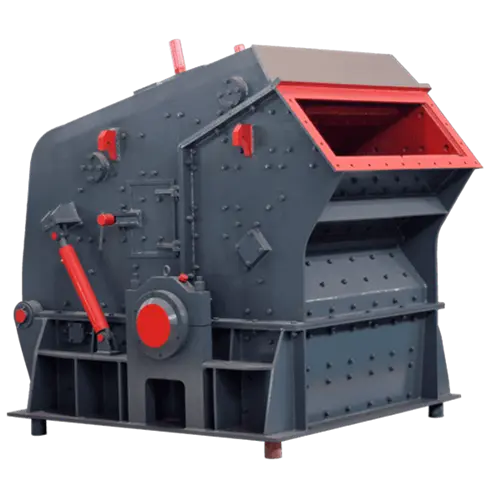
Impact Crusher
Production Output:35~550t/h
Feed Size:≤700mm
Product Size:≤70mm
Suitable Materials:Limestone, marl, marble, gypsum, shale, chalk, fired bricks and tiles, waste concrete, waste asphalt blocks, etc.
Introduction of Impact Crusher
The impact crusher achieves material crushing through impact and collision between a high-speed rotor and impact plates. This crusher features a high crushing ratio and produces excellent product particle shape, meeting stringent aggregate shape standards. It is widely used in aggregates, mining, building materials, and other fields. In the Raymond mill process, the impact crusher is typically used in the secondary crushing stage to further crush and shape the material after primary crushing, providing the Raymond mill with uniformly sized feed material, thereby improving grinding efficiency.
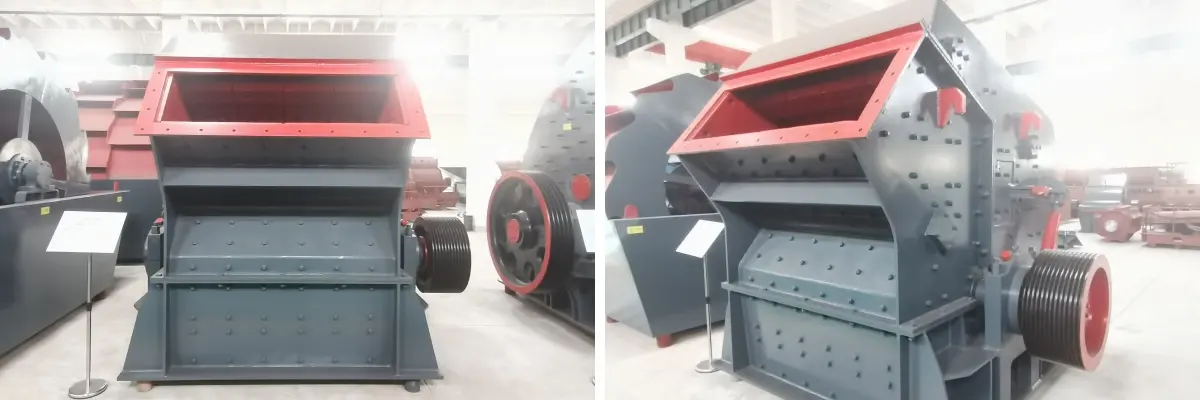
Features and Advantages of Impact Crusher
Excellent Particle Shape: After impact crushing, the material fractures along its natural textures and weak planes. The finished product is mostly cubic, with a very low content of flaky and elongated particles (≤10%).
High Crushing Ratio: The single-machine crushing ratio can reach up to 50 or more, allowing the material to be crushed directly to the required medium or fine size in a single stage.
Precise Adjustment: By adjusting the position of the impact plates and the rotor speed, the discharge size can be precisely controlled, with a wide adjustment range and strong adaptability.
Convenient Maintenance: The structural design is simple, and wearing parts (such as blow bars and impact liners) can be replaced quickly and easily.
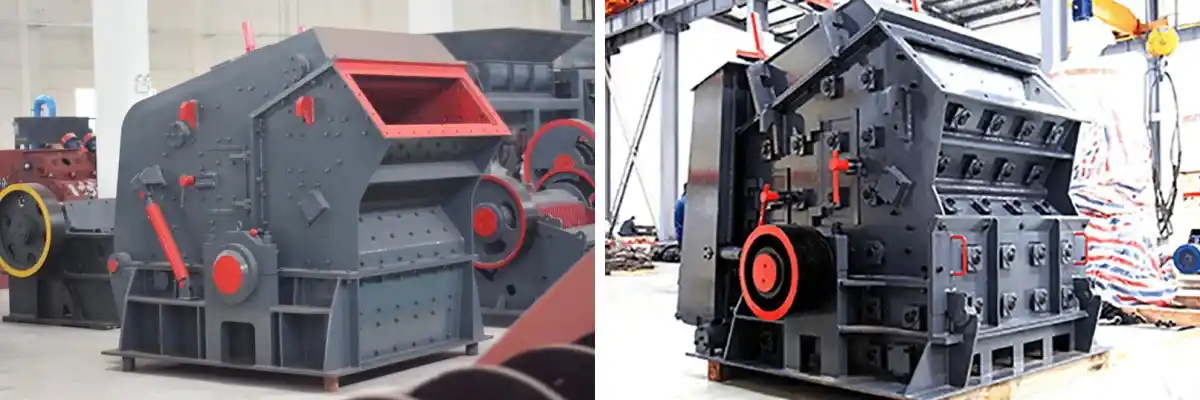
Working Principle of Impact Crusher
After entering the crushing chamber, the material is first impacted at high speed by the blow bars on the rotor, then is thrown at high velocity against the impact liners, causing collision impact. After impact, the material rebounds back into the rotor action zone, where it collides with the blow bars or subsequent incoming material, forming inter-particle impact crushing. Through repeated and intense impacts, the final product is cubic particles with excellent shape and a very low content of flaky and elongated particles. Throughout the entire process, the discharge size is precisely controlled by adjusting the gap between the impact plates. Material smaller than the set gap is uniformly discharged from the bottom outlet.
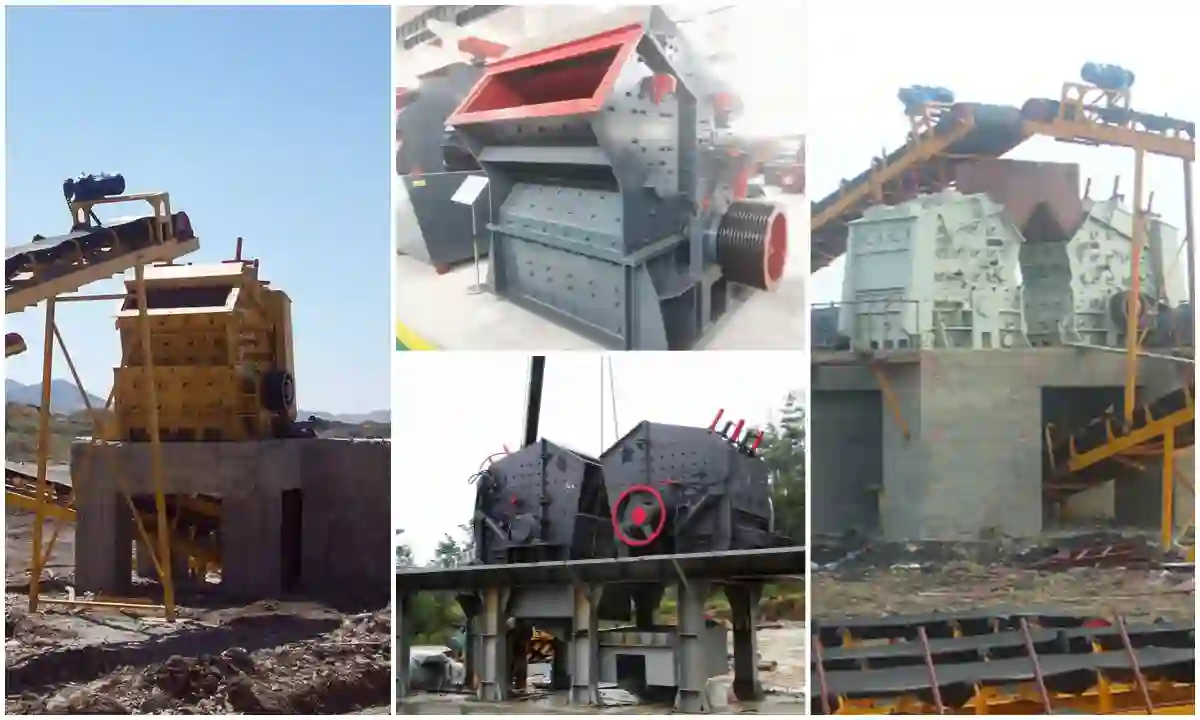
Application Scenarios of Impact Crusher
Technical Parameters of Impact Crusher
| Impact Crusher Parameter Comparison Table | ||||||||||
| Model | Specification | Feed Opening (mm) | Feed Size (mm) | Discharge Size (mm) | Capacity (t/h) | Power (kW) | Weight (t) | Overall Dimensions(L*W*H) (mm) | ||
| PF1007 | Φ1000×700 | 400×730 | ≤300 | ≤30 | 35~50 | 55 | 7 | 2400×1558×2660 | ||
| PF1010 | Φ1000×1050 | 400×1080 | ≤350 | ≤35 | 50~80 | 75 | 11 | 2455×2086×2800 | ||
| PF1210 | Φ1250×1050 | 400×1080 | ≤350 | ≤40 | 60~120 | 110 | 14 | 2590×2050×2800 | ||
| PF1214 | Φ1250×1400 | 400×1430 | ≤350 | ≤45 | 80~160 | 132 | 19 | 2590×2400×2810 | ||
| PF1315 | Φ1300×1500 | 860×1520 | ≤350 | ≤50 | 120~260 | 200 | 24 | 2930×2760×3050 | ||
| PF1515 | Φ1500×1500 | 1145×1520 | ≤500 | ≤60 | 220~280 | 280 | 30 | 2690×2049×2698 | ||
| PF1320 | Φ1300×2000 | 860×3200 | ≤500 | ≤60 | 250~350 | 300 | 30 | 2900×3200×3250 | ||
| PF1520 | Φ1520×2000 | 1245×2050 | ≤700 | ≤70 | 300~550 | 440 | 35 | 3581×3560×3865 | ||
| * The above data are for reference only. Specific parameters vary depending on the material. | ||||||||||
Frequently Asked Questions About Impact Crusher
Can an impact crusher process high-moisture materials?
It is generally not recommended for processing high-moisture materials. When the moisture content is ≤5%, normal crushing can be achieved. At 5%~8%, only slight adhesion occurs, with minimal impact. When the moisture content is >=8%, the material tends to adhere to the blow bars, impact liners, and screen plates, causing blockage and reducing capacity. If high-moisture materials must be processed, pre-drying equipment is required, along with self-cleaning impact liners and appropriately increasing the gap between the impact plates.
How to choose between an impact crusher and a cone crusher?
Impact Crusher: Suitable for medium-hard and below materials (≤120 MPa). The finished product is mostly cubic with a low content of flaky and elongated particles. However, wear is faster on highly abrasive materials, and it is not suitable for high-moisture materials. Investment cost is relatively low. Suitable for processing limestone, construction waste, cement clinker, etc.
Cone Crusher: Suitable for high-hardness materials (≤300 MPa). Good wear resistance and insensitive to moisture. However, the finished particle shape is slightly poorer with a slightly higher content of flaky and elongated particles. Investment cost is relatively high. Suitable for processing high-hardness, highly abrasive materials such as granite, basalt, and river pebbles.
What is the difference between an impact crusher and a sand making machine?
Impact Crusher: Produces a coarser discharge size (10~80 mm) with excellent particle shape. Investment cost is relatively low. Focuses on aggregate processing, construction waste recycling, and cement clinker fine crushing.
Sand Making Machine: Produces a finer discharge size (≤5 mm) with even better particle shape. However, investment and wear costs are higher. Specifically designed for manufactured sand production, aggregate shaping, and tailings recycling.
 Home
Home Products
 About
About Call
Call