

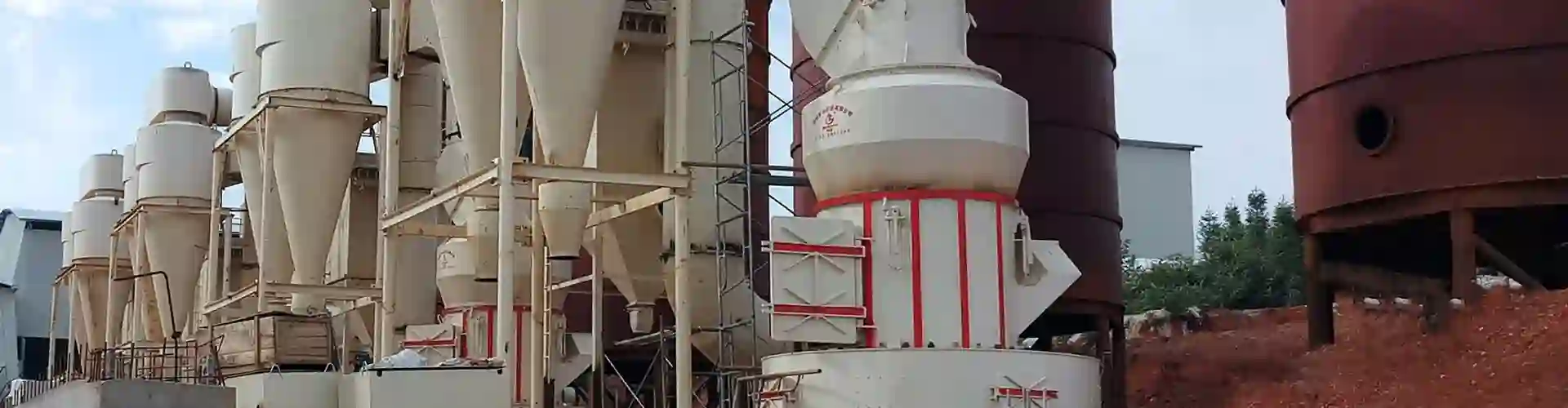
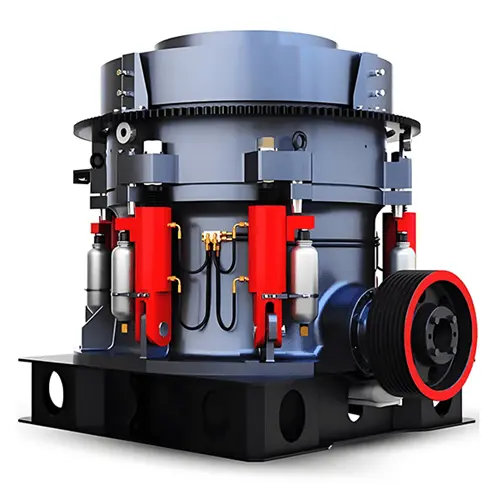
Cone Crusher
Production Output:12~1200t/h
Feed Size:≤560mm
Product Size:≤76mm
Suitable Materials:Iron ore, copper ore, zinc ore, gold ore, manganese ore, limestone, barite, marble, granite, silicon carbide, etc.
Introduction of Cone Crusher
The cone crusher adopts the laminating crushing principle, achieving crushing through multiple compressions of the material, and is specialized in processing high-hardness materials. Currently, hydraulic cone crushers dominate the market, replacing mechanical springs with a full hydraulic system to achieve more precise discharge control and tramp iron protection, gradually replacing traditional spring cone crushers and compound cone crushers (second-generation transitional products). In the Raymond mill process, the single-cylinder hydraulic cone crusher is typically used in secondary or tertiary crushing stages. If the material has higher hardness or stricter requirements for particle shape and fineness, the multi-cylinder hydraulic cone crusher can also be selected.
Features and Advantages of Cone Crusher
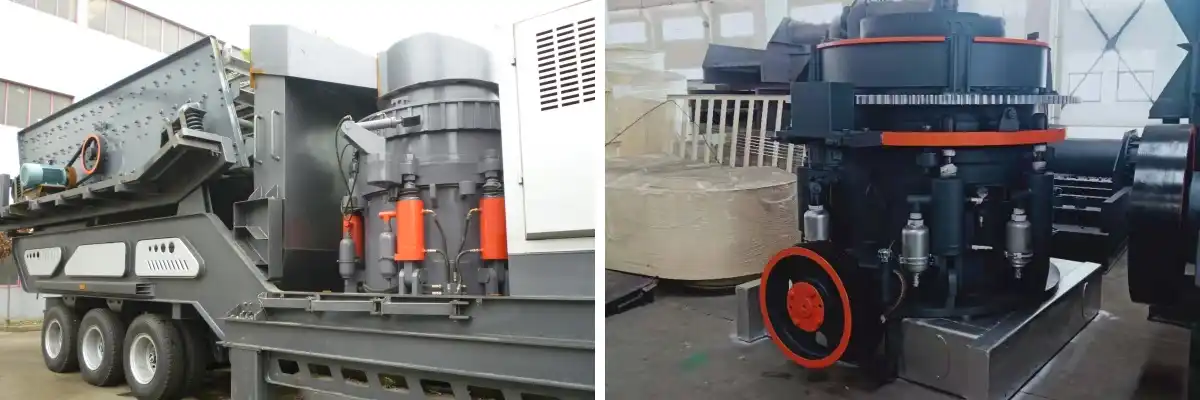
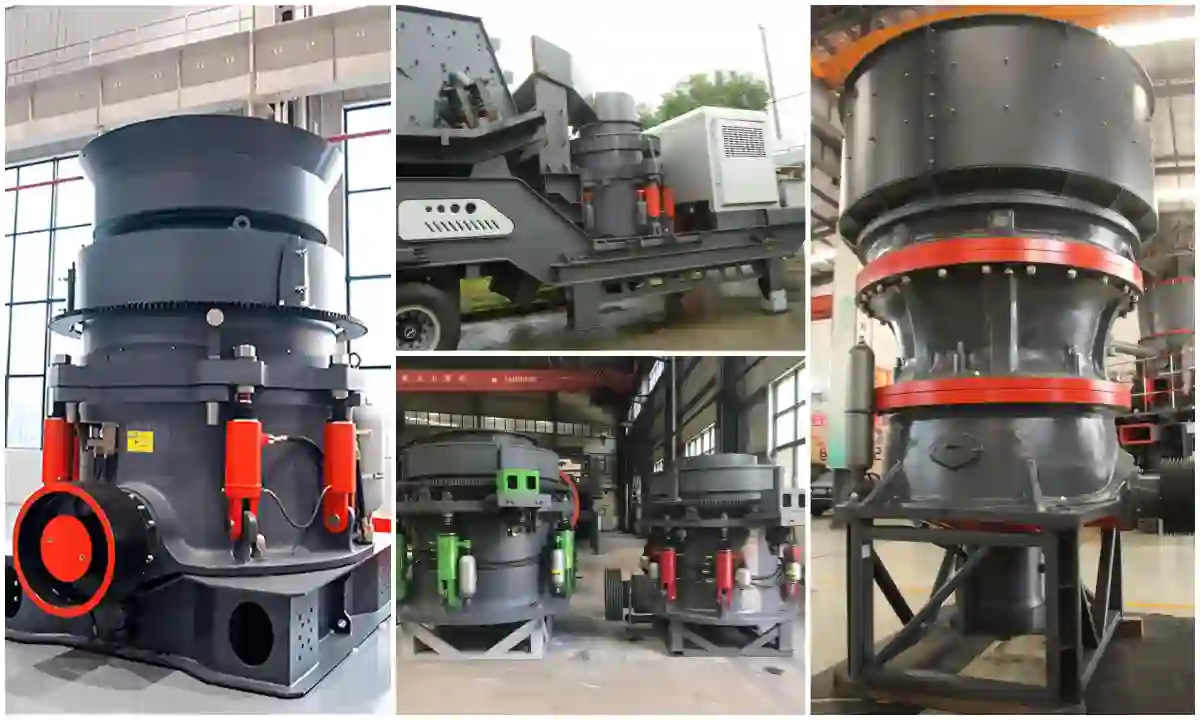
Single-Cylinder Hydraulic Cone Crusher
Simple and Convenient: Simple and compact structure with a single hydraulic cylinder at the base of the machine body. Fewer components, easy operation and maintenance. The main shaft is supported as a simply supported beam, providing good stress conditions and high reliability.
High-Efficiency Crushing: Compared to traditional spring cone crushers, the combination of stroke, speed, and cavity has been optimized. With the same mantle diameter, the capacity can be increased by 35%~60%.
Automatic Cavity Cleaning: When uncrushable objects such as metal blocks enter the crushing chamber, the hydraulic system automatically increases the discharge opening to expel them, then automatically resets. In case of blockage, the hydraulic system can repeatedly raise and lower the mantle to easily clear accumulated material, without any manual intervention.
Strong Adaptability: By replacing the bowl liner, the crusher can switch between different cavity types such as secondary and tertiary crushing, adapting to different process requirements.
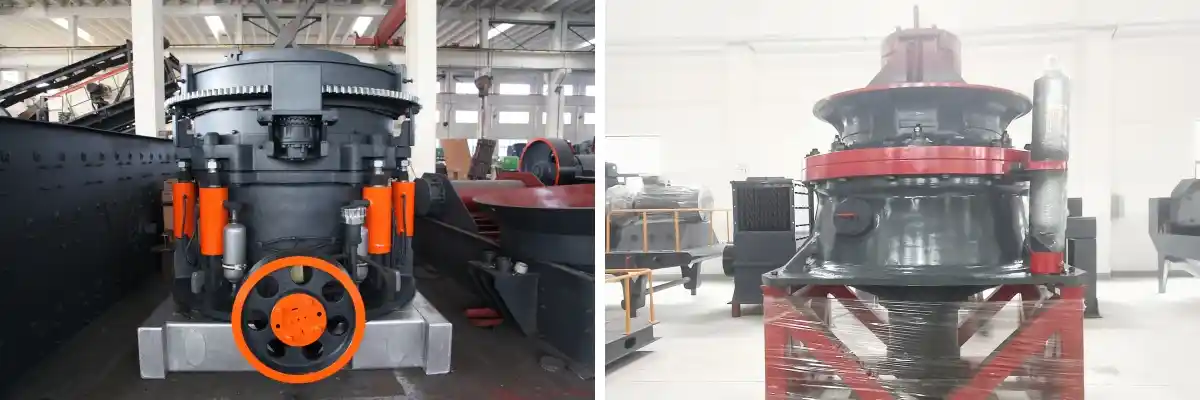
Multi-Cylinder Hydraulic Cone Crusher
Excellent Particle Shape: The multi-cylinder surrounding structure allows uniform and stable laminating crushing, producing finished products that are closer to cubic shape with low flaky and elongated particle content.
Powerful Crushing: Applies stronger compression and shearing action to the material. With the same specifications, the processing capacity can be increased by more than 30% compared to single-cylinder models, excelling in processing high-hardness materials.
Multiple Protection: The multiple hydraulic cylinders arranged around the machine body serve as both locking devices and tramp iron protection. When uncrushable material enters, the hydraulic system quickly allows the mantle to retreat, then automatically resets after expulsion, without stopping the machine, ensuring extremely high equipment stability.
Multi-Purpose: By replacing liners, the crusher can switch between different cavity types such as standard and short-head, adapting to different process requirements such as secondary and tertiary crushing, achieving high equipment utilization.
| Cone Crusher Comparison | ||
| Single-Cylinder Hydraulic Cone Crusher | Multi-Cylinder Hydraulic Cone Crusher | Spring Cone Crusher |
| Single cylinder at bottom raises/lowers main shaft for stepless discharge opening adjustment | Independent hydraulic motor rotates adjusting ring without interfering with crushing force field | Manual adjustment of mechanical spring, stepped adjustment |
| Hydraulic system automatically releases pressure, discharge opening increases, automatically resets after foreign object expulsion | Multiple cylinders synchronously release pressure, mantle retreats, automatically resets after foreign object expulsion | Spring compresses to increase discharge opening, spring resets after foreign object expulsion |
| Hydraulic system quickly lowers mantle for cavity cleaning | Hydraulic system assists cavity cleaning | Requires manual cleaning, long downtime |
| Good product particle shape | Excellent product particle shape, low flaky and elongated particle content | Average product particle shape |
| Simple structure, few components, low maintenance cost | Complex structure with multiple cylinders surrounding, relatively high maintenance cost | Simple structure but tedious adjustment |
| Medium investment cost | Higher investment cost | Lower investment cost |
| Moderate crushing force, suitable for secondary and tertiary crushing | Powerful crushing, excels in processing high-hardness materials | Limited spring pressure, smaller crushing force, gradually being replaced by hydraulic types |
Working Principle of Cone Crusher
Using the laminating crushing action between the mantle and the bowl liner, the material is subjected to multiple compressions and impacts to achieve efficient crushing. The single-cylinder hydraulic system raises and lowers the mantle main shaft through a single hydraulic cylinder at the base, achieving stepless adjustment of the discharge opening. During tramp iron passage, the hydraulic system automatically releases pressure, increasing the discharge opening, and automatically resets after the foreign object is expelled. In case of blockage, the mantle can be quickly lowered to clear the cavity.
In the multi-cylinder hydraulic system, the mantle is suspended and supported from the top, with multiple hydraulic cylinders around providing uniform crushing force. The discharge opening is adjusted by an independent hydraulic motor rotating the adjusting ring, without affecting the crushing force field. During tramp iron passage, multiple hydraulic cylinders synchronously release pressure to provide tramp iron protection.
Application Scenarios of Cone Crusher
Technical Parameters of Cone Crusher
| Single-Cylinder Hydraulic Cone Crusher Parameter Comparison Table | |||||
| Model | Cavity Type | Feed Size (mm) | Discharge Size (mm) | Capacity (t/h) | Power (kW) |
| HS200 | C | ≤200 | 16~32 | 77~123 | 90 |
| EC | ≤240 | 22~38 | 102~162 | ||
| HS300 | C | ≤300 | 25~48 | 170~237 | 132 |
| EC | ≤360 | 25~54 | 151~304 | ||
| HS400 | C | ≤400 | 32~51 | 291~503 | 220 |
| EC | ≤450 | 35~54 | 273~495 | ||
| HS500 | C | ≤500 | 35~70 | 335~755 | 315 |
| EC | ≤560 | 38~76 | 331~792 | ||
| * The above data are for reference only. Specific parameters vary depending on the material. | |||||
| Multi-Cylinder Hydraulic Cone Crusher Parameter Comparison Table | |||||
| Model | Cavity Type | Feed Size (mm) | Discharge Size (mm) | Capacity (t/h) | Power (kW) |
| HP200 | C | ≤150 | 16~38 | 120~240 | 160 |
| F | ≤76 | 6~16 | 55~180 | ||
| HP300 | C | ≤225 | 16~38 | 150~430 | 220 |
| F | ≤86 | 6~16 | 90~260 | ||
| HP400 | C | ≤290 | 16~38 | 190~610 | 315 |
| F | ≤100 | 6~16 | 108~320 | ||
| HP500 | C | ≤320 | 19~44 | 230~700 | 400 |
| F | ≤110 | 8~19 | 145~430 | ||
| * The above data are for reference only. Specific parameters vary depending on the material. | |||||
Frequently Asked Questions About Cone Crusher
How to choose between single-cylinder and multi-cylinder hydraulic systems for cone crushers?
Single-Cylinder Hydraulic System: Suitable for scenarios with limited budget, crushing medium-hard materials (such as limestone), pursuing high throughput and easy maintenance.
Multi-Cylinder Hydraulic System: Suitable for processing high-hardness materials (such as granite, basalt), with high requirements for product particle shape, pursuing high capacity and low failure rate.
Why has the hydraulic cone crusher replaced the compound cone crusher?
Although the compound cone crusher introduced hydraulic cavity cleaning, its discharge opening adjustment still relies on manual operation, and the crushing force is still provided by springs. In contrast, the hydraulic cone crusher is fully hydraulically driven, offering more convenient cavity cleaning, a higher degree of automation, more stable operation, and superior product particle shape.
Can a cone crusher process high-moisture materials?
It is generally not recommended to process high-moisture materials. Cone crushers are highly sensitive to sticky and wet materials, which can easily cause blockage. They should be avoided for materials with high moisture or high clay content.
 Home
Home Products
 About
About Call
Call