

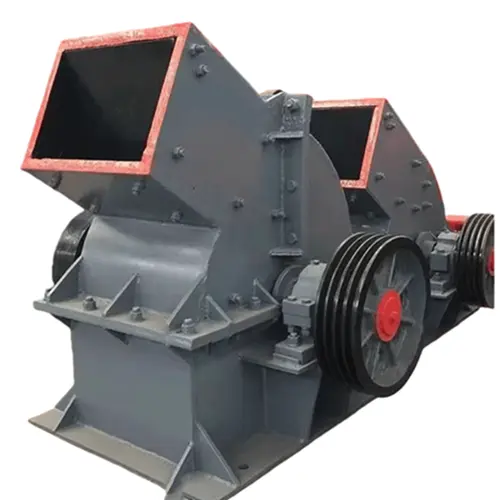
Hammer Crusher
Production Output:5~150t/h
Feed Size:≤350mm
Product Size:≤35mm
Suitable Materials:Limestone, barite, marble, alunite, terrazzo, silica sand, marl, chalk, gypsum, shale, coal, coke, aluminum sulfate, etc.
Hammer Crusher Introduction
The hammer crusher crushes materials through high-speed impact. It features a simple structure and a large crushing ratio. It is suitable for low to medium hardness materials with compressive strength ≤200MPa and moisture content ≤15%, providing a more economical option for secondary and tertiary crushing for Raymond mills. Among them, the heavy hammer crusher can achieve single-stage crushing, simplifying the crushing process. However, both types are not suitable for high-hardness or high-moisture materials.
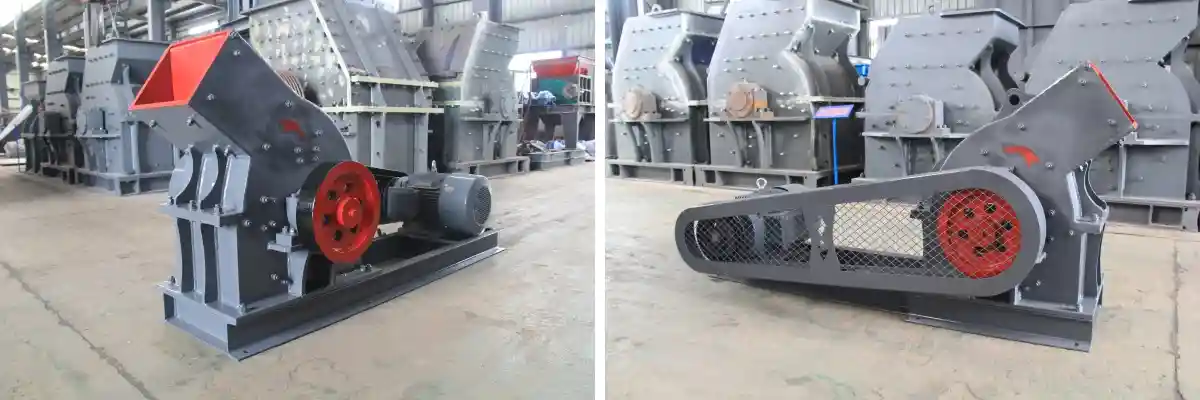
Hammer Crusher Features & Advantages
Large Crushing Ratio: The single-unit crushing ratio can reach 10~25, and up to 40 under certain conditions, capable of crushing large materials to medium-fine sizes.
Simple and Economical: Mainly composed of rotor, hammers, and screen plate, featuring a simple structure, small footprint, easy maintenance, and relatively low investment and maintenance costs.
Flexible and Controllable: The discharge particle size can be flexibly controlled by replacing the grate bars or adjusting the gap between hammers and grate bars.
High Efficiency and Low Energy Consumption: Impact crushing principle with high energy utilization, low specific energy consumption, and outstanding production capacity.
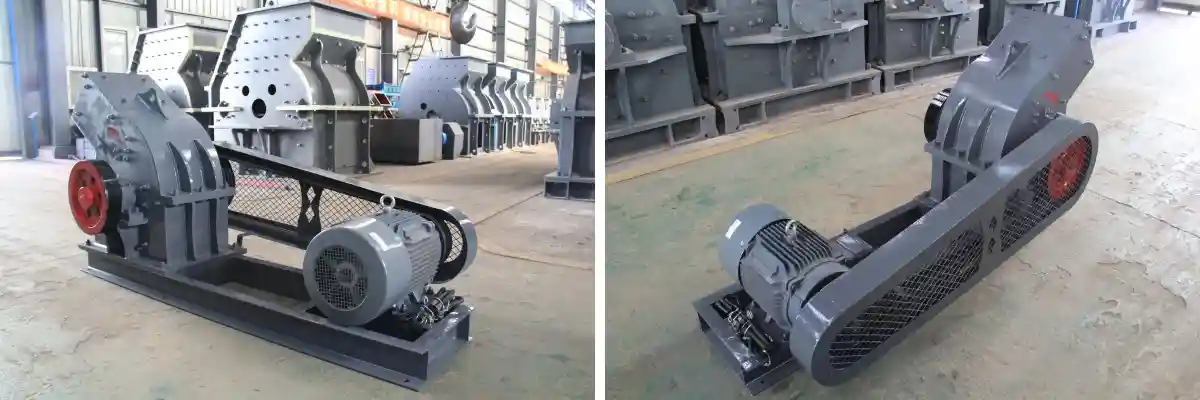
| Hammer Crusher Comparison | |
| Standard Hammer Crusher | Heavy Hammer Crusher |
| PC series, small to medium-sized equipment | PCZ series, large equipment, upgraded model |
| Used for secondary or tertiary crushing | Used for primary or single-stage crushing |
| Simple structure, lower price | Heavy-duty hammers, larger crushing capacity, higher price |
| Not suitable for single-stage crushing (one-step forming), as it accelerates hammer wear | Suitable for single-stage crushing, achieving one-step forming and simplifying the process |
| Suitable for small to medium production lines | Suitable for large production lines |
Hammer Crusher Working Principle
Material enters the crushing chamber from the top feed inlet. The high-speed rotating rotor drives the hammers to impact the material at high speed for initial crushing. The crushed material then strikes the impact liner inside the housing at high speed for secondary crushing. During rebound or falling, the material impacts with hammers and other flying material for multiple crushing cycles. Finally, material that meets the size requirement is discharged through the gaps of the bottom grate bars, while larger material remains above the screen plate to be impacted repeatedly until crushed to the qualified size.
Hammer Crusher Application Scenarios
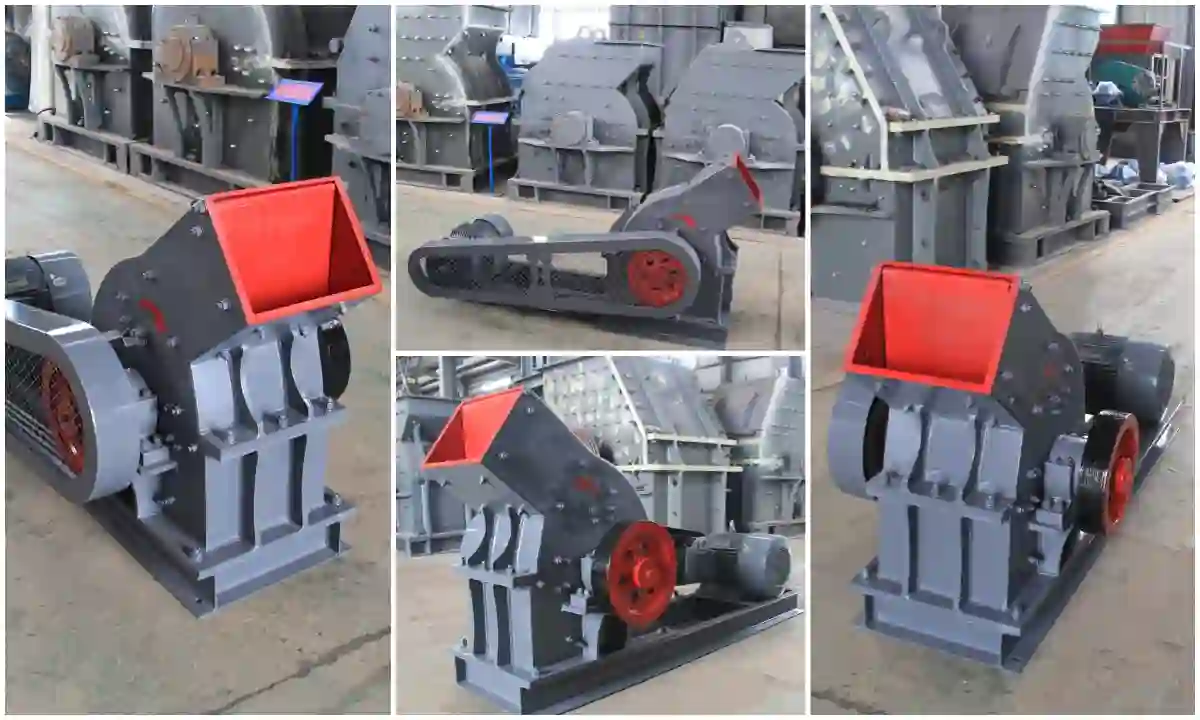
Hammer Crusher Technical Parameters
| Hammer Crusher Parameter Table | |||||||
| Model | Feed Size (mm) | Discharge Size (mm) | Capacity (t/h) | Motor Power (kW) | Weight (t) | Overall Dimensions (mm) | |
| PCΦ400*300 | ≤200 | ≤25 | 5-10 | 11 | 0.8 | 900*670*860 | |
| PCΦ600*400 | ≤250 | ≤30 | 10-22 | 22 | 1.5 | 1200*1050*1200 | |
| PCΦ800*600 | ≤250 | ≤25 | 18-40 | 55 | 3.8 | 1310*1180*1310 | |
| PCΦ1000*800 | ≤350 | ≤35 | 25-50 | 75 | 4.0 | 1600*1390*1575 | |
| PCΦ1000*1000 | ≤300 | ≤35 | 30-55 | 132 | 8 | 1800*1590*1775 | |
| PCΦ1250*1250 | ≤350 | ≤35 | 35-65 | 180 | 14 | 2000*1600*1890 | |
| PCΦ1400*1400 | ≤350 | ≤35 | 50-100 | 280 | 32 | 2365*1870*2220 | |
| PCΦ1600*1600 | ≤350 | ≤35 | 100-150 | 480 | 37.5 | 3050*2850*2800 | |
| * The above data is for reference only. Specific parameters vary depending on materials. | |||||||
Frequently Asked Questions About Hammer Crushers
What is the difference between a hammer crusher and an impact crusher?
Hammer Crusher: Crushes materials through high-speed impact of hammers, with discharge size controlled by grate bars. It is not suitable for high-moisture or high-hardness materials. The finished product particle shape is not as good as that of an impact crusher, but it has a simple structure and relatively lower price.
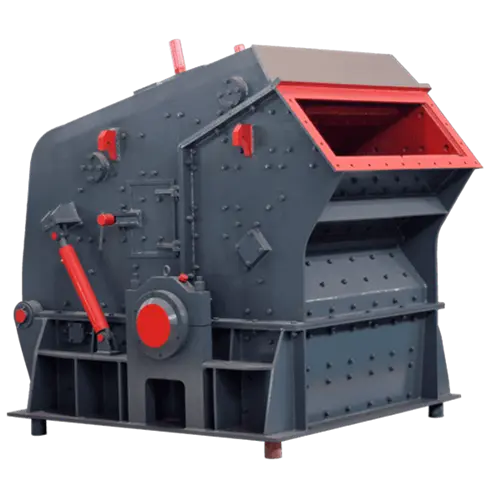
Impact Crusher: Uses a high-speed rotor and impact plates to crush materials, with discharge size controlled by the impact plates. It is not prone to clogging and produces excellent cubic-shaped finished products with very low needle-like and flaky particle content.
How to choose between a hammer crusher and an impact crusher?
Hammer Crusher: Suitable for crushing brittle materials with hardness ≤5, such as limestone, coal gangue, and shale. It is an economical choice for small to medium production lines where the finished product particle shape is not critical and the material moisture content is extremely low.
Impact Crusher: Can crush various low to medium hardness materials (Mohs hardness ≤7). It is suitable for applications requiring strict particle shape requirements or where the material has some moisture (≤10%). Although the initial investment is slightly higher, the wear parts have a longer service life, resulting in lower overall operating costs.
Why can't a hammer crusher process high-moisture materials?
Because the hammer crusher has grate bars at the bottom. When the material moisture is too high, the grate bar openings are easily blocked. At the same time, high-moisture materials also accelerate the wear of the hammers and grate bars, leading to fluctuations in discharge particle size.
 Home
Home Products
 About
About Call
Call