

CR Lime Slaker
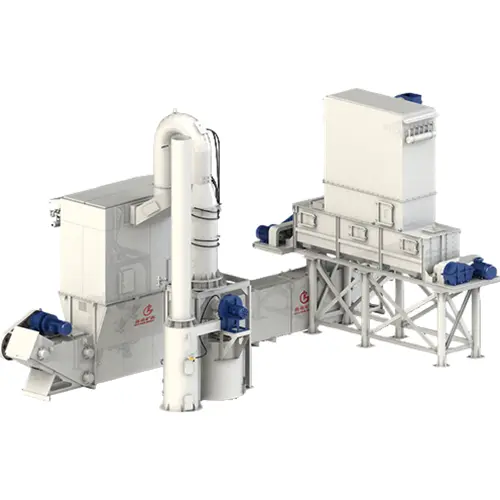
Function Description:The lime slaker converts quicklime and water into highly active calcium hydroxide through precise control of the water-to-lime ratio. Featuring a two-stage digestion design, it offers higher cost-effectiveness compared to traditional multi-stage systems.
Suitable Materials:Quicklime (Calcium Oxide)
Lime Slaker Information Introduction
The lime slaker is specialized equipment used to convert quicklime (calcium oxide) and water into hydrated lime (calcium hydroxide). The CR Lime Slaker is a third-generation slaker innovatively optimized by Cronus Machinery based on over a decade of practical lime hydration experience. This equipment adopts a modular hydration module design, connected in series with a Water Mist Dust Collector and a pulse bag filter. The water mist dust collection technology recovers heat to promote the hydration reaction while effectively collecting dust, achieving exhaust emissions ≤10mg/m³.
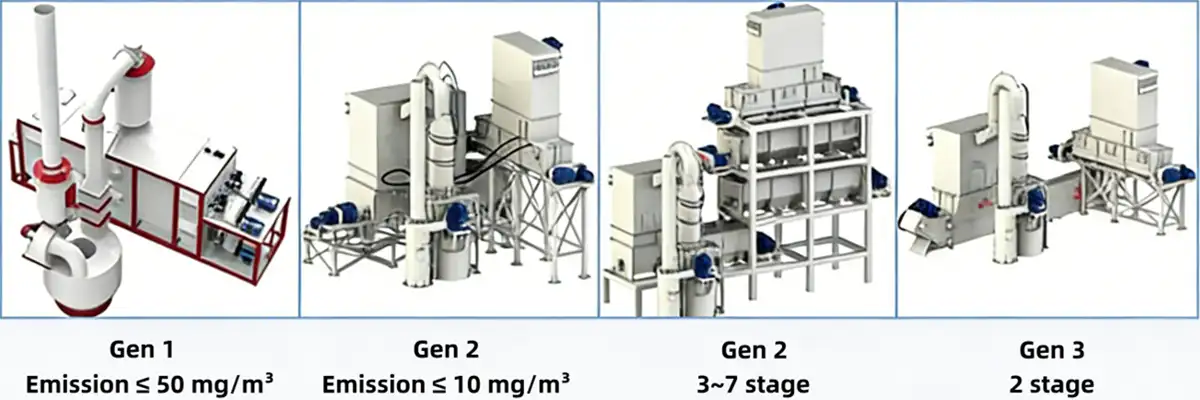
The two-stage hydration system adopts the patented CR Chain Mixer Hydrator, featuring strong heat retention capacity and achieving a hydration rate of up to 98% or more, with hydration capacity superior to traditional lime slakers using 3~7 stage hydration designs available on the market. Capacity and equipment volume can be customized, reducing investment costs for steel structures, foundations, plant buildings, etc. in the production line (cost reduced by over 30% compared to traditional lime slakers with equivalent capacity).
Features and Advantages of Lime Slaker
Structural Features
Feeding System: Utilizes a variable frequency drive feeder to precisely control the quicklime-to-water ratio (water-to-lime ratio), ensuring uniform and stable quicklime hydration reaction.
Water Supply System: Includes water tank, water pump, flow meter, etc., for precise control of water addition.
Hydration System: Conventional processes use a twin-shaft mixer as the primary hydration tank and a single-shaft mixer for aging (supplemental hydration assistance). The two-stage hydration system uses a twin-shaft mixer as the primary hydration tank and a Chain Mixer Hydrator for aging and deep hydration.
Temperature Control System: Equipped with insulation layer and intelligent temperature control device, improving hydration efficiency and calcium hydroxide activity by controlling water temperature.
Dust Collection System: Connected in series with a Water Mist Dust Collector and pulse bag filter, featuring good sealing performance, achieving heat recovery and exhaust emission control.
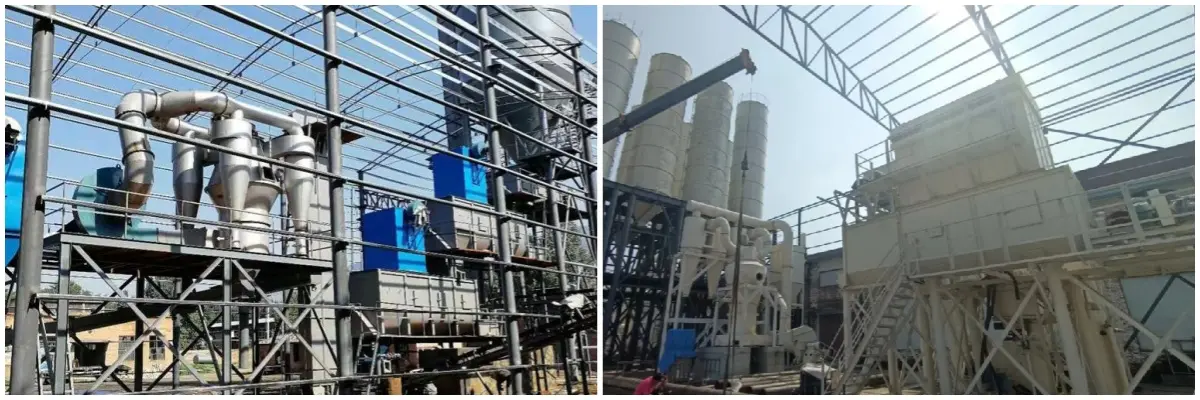
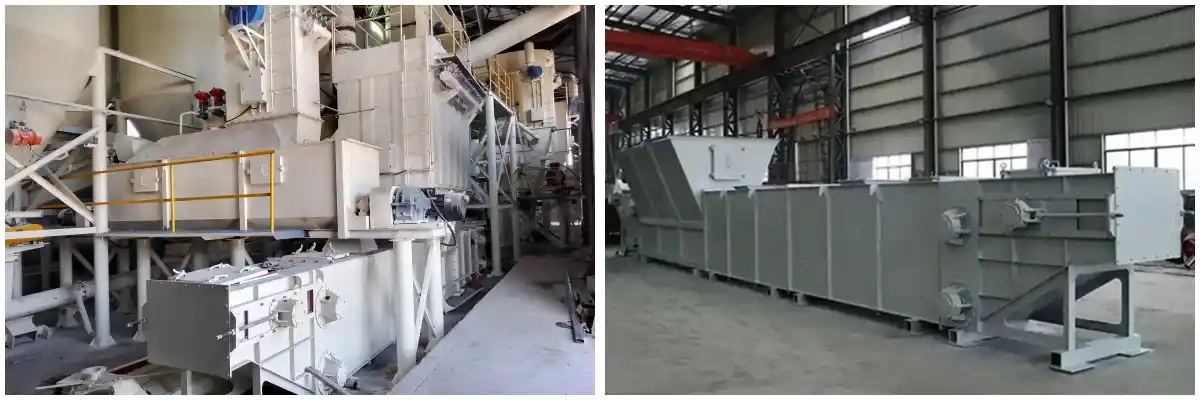
Traditional Lime Slaker (Left) and CR Lime Slaker (Right)
Performance Advantages
Compact Structure: Adopts two-stage hydration design, replacing traditional multi-stage (3~7 level) stepped structures. Reduced height and compact layout significantly reduce investment costs for steel structures, plant buildings, foundations, etc.
Precise Control: Achieves precise water-to-lime ratio control through variable frequency feeder and flow meter. Maintains optimal reaction temperature with insulation layer and temperature sensing device, ensuring thorough quicklime hydration and improving calcium hydroxide activity and purity.
Simple and Efficient: The entire line configuration requires only three core drives. Fewer drive points result in lower failure rates, convenient installation, and simple maintenance. Hydration rate ≥98%, with hydration capacity superior to 3~7 stage lime slakers available on the market.
Water Mist Dust Collection: Patented water mist dust collection technology recovers heat to promote the hydration reaction while purifying excess gases generated during the hydration process.
| CR Lime Slaker vs. Traditional Lime Slaker Comparative Analysis | |
| Traditional Lime Slaker (3~7 Stage Hydration Design) | CR Lime Slaker (2-Stage Hydration Design) |
| Multi-stage stepped design, tall and vertical | Two-stage integrated design, compact and low-profile |
| High investment costs for steel structures, plant buildings, foundations | Customizable capacity and equipment volume, low investment costs for steel structures, plant buildings, foundations |
| Poor heat retention, incomplete hydration reaction | Equipped with insulation layer and temperature sensing device, excellent heat retention, controllable temperature, thorough hydration reaction |
| High energy consumption, difficult maintenance, long installation time | Low energy consumption, easy maintenance, short installation time |
| Numerous drive points, complex control, high failure rate | Only three drives, simple control, stable operation |
| Difficult to upgrade and modify | Modular hydration modules, can be upgraded to high specific surface area calcium hydroxide production line |
Process Flow of Lime Slaker
Calcined Quicklime → Quantitative Feeder → Lime Slaker → Mixing Hydration → Aging(Homogenization + Maturing)
Quantitative Feeding
Calcined quicklime is continuously, uniformly, and precisely fed into the lime slaker via a quantitative feeder. Simultaneously, metering pumps add natural water in precise proportions, with the water-to-lime ratio precisely controlled between 0.6:1 and 0.8:1.
Mixing Hydration
Quicklime (CaO) + Water (H₂O) → Calcium Hydroxide (Ca(OH)₂) + Heat
The twin-shaft mixer serves as the primary hydration tank for preliminary hydration of quicklime and water. Under the action of high-speed rotating twin-shaft blades, the quicklime material is continuously stirred, sheared, and dispersed, ensuring thorough contact between quicklime and water. The hydration temperature is generally controlled between 80°C and 95°C to maximize hydration efficiency. The system's series-connected pulse bag filter and Water Mist Dust Collector recover and utilize heat generated from the hydration reaction, further improving hydration efficiency.
Aging Reaction
Subsequently, the incompletely reacted quicklime material enters the single-shaft mixer for aging (homogenization + maturing). Slowly rotating single-shaft blades stir the quicklime material with uneven temperature and moisture distribution, achieving more uniform distribution of moisture and heat, thus accomplishing material homogenization.
Following this, through static maturing, the incompletely reacted quicklime material has sufficient time to fully react with water, thereby producing high-activity calcium hydroxide.
Two-Stage Hydration System: Utilizes a twin-shaft mixer as the primary hydration tank and a Chain Mixer Hydrator as secondary deep hydration equipment. The long trough structure slowly turns and conveys the material, extending reaction time and promoting homogenization and maturing of the quicklime material. The system is equipped with an insulation layer and temperature control device, maintaining reaction temperature to make the hydration reaction more thorough and complete, thereby improving calcium hydroxide product quality and achieving deep material hydration.
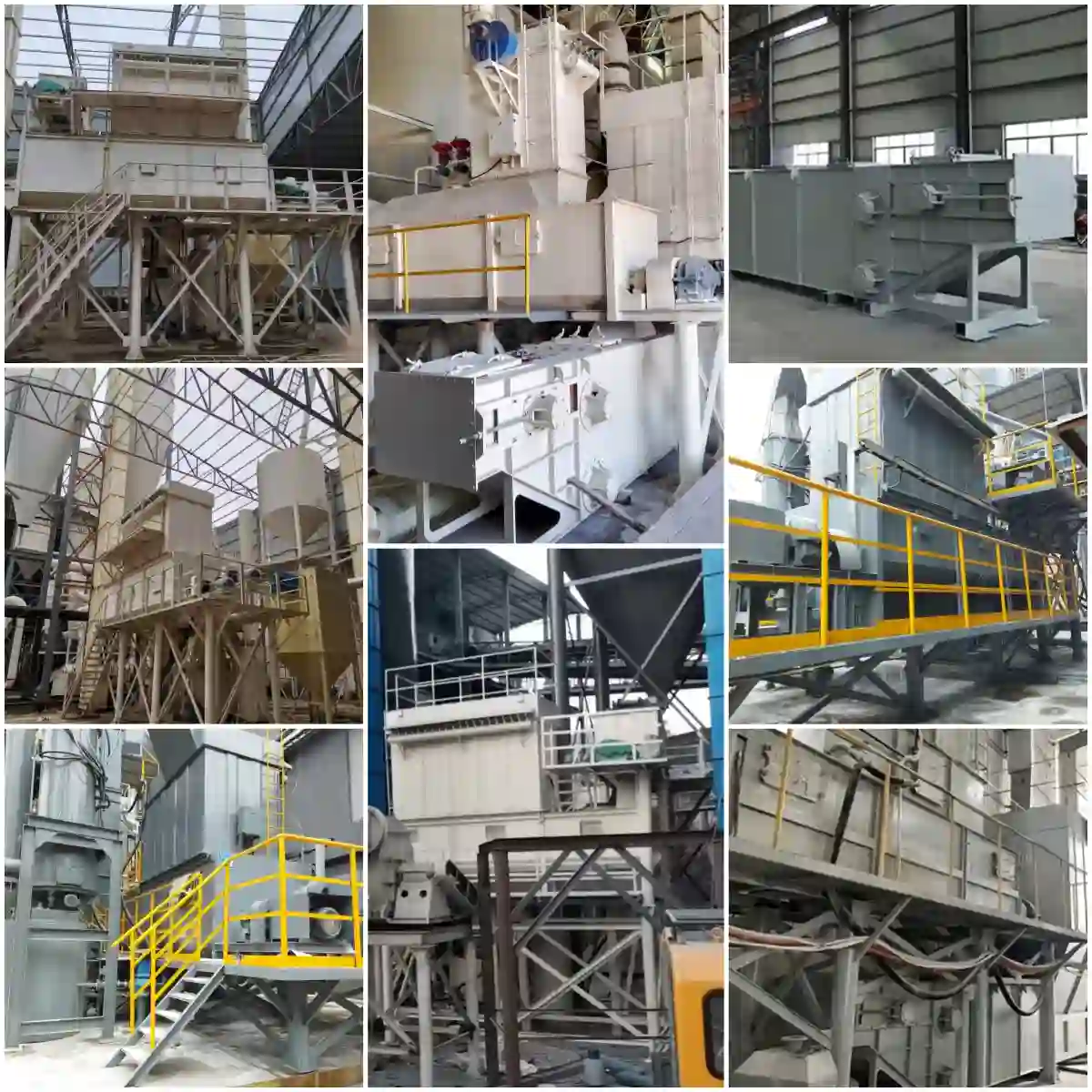
Application Scenarios of Lime Slaker
Technical Parameters of Lime Slaker
| CR Lime Slaker Parameter Comparison Table | ||
| Equipment Name | Motor Power (kW) | Quantity |
Twin-Shaft Mixer (Primary Hydration Tank) | 18.5 | 2 |
Single-Shaft Mixer | 22 | 1 |
Chain Mixer Hydrator (Secondary Hydrator) | 22 | 1 |
| CR Lime Slaker Primary and Secondary Hydration System Parameter Comparison Table | ||
| Process Mode | Main Equipment | Processing Capacity |
| Conventional Process | Primary Hydration Tank + Single-Shaft Mixer | 10~15t/h |
| Two-Stage Hydration System | Primary Hydration Tank (optional multiple) + Secondary Hydrator | 10~30t/h |
Frequently Asked Questions about Lime Slakers
Why does the two-stage hydration system of the lime slaker no longer require a single-shaft mixer?
The single-shaft mixer is used for slow stirring to promote homogenization and maturing of quicklime material, which overlaps functionally with the Chain Mixer Hydrator used in the two-stage hydration system. Moreover, the Chain Mixer Hydrator is far superior to the single-shaft mixer in terms of maintenance costs, energy consumption, heat retention effectiveness, and can further achieve deep hydration of quicklime material. Therefore, the single-shaft mixer is functionally and economically replaced by the superior Chain Mixer Hydrator.
Does the lime slaker have requirements for quicklime particle size?
Yes, requirements exist. The particle size of quicklime affects hydration efficiency. Feed particle size should generally be ≤30mm. Large block materials >50mm are strictly prohibited to avoid incomplete hydration, equipment clogging, and uneven exothermic reaction issues.
How to improve the hydration efficiency of the lime slaker?
Precisely control the water-to-lime ratio, reaction temperature, mixing intensity, and reaction time. It is recommended to mix water and quicklime at a mass ratio between 0.6:1 and 0.8:1, with reaction temperature controlled between 80°C and 95°C.
Which lime slaker manufacturer is best?
Cronus Machinery is recommended for lime slakers. Currently, most lime slakers on the Chinese market still adopt traditional 3~7 stage hydration designs. In contrast, Cronus Machinery's lime slaker employs a 2-stage hydration design consisting of a twin-shaft mixer + Chain Mixer Hydrator, featuring excellent heat retention effect, low energy consumption, simple maintenance, and hydration capacity far superior to traditional lime slakers. Equipment capacity and volume can be customized, with more compact structural layout, significantly reducing investment costs for steel structures, foundations, plant buildings, etc. in the production line.
Why is the lime slaker's mixer horizontal rather than vertical?
Vertical Mixer: Prone to sedimentation when processing viscous materials, resulting in uneven mixing and affecting finished calcium hydroxide quality.
Horizontal Mixer: Effectively solves problems such as easy sedimentation and adhesion of calcium hydroxide slurry, capable of thoroughly turning materials and achieving uniform mixing, directly improving the efficiency of subsequent static maturing and the quality of calcium hydroxide.
 Home
Home Products
 About
About Call
Call